


The Whole List of All Three MICHELIN Key Hotels in 2026
Release date: 2026-10-07Release Date: 2026-08-27 16:14:14
Most advice about duvet covers for hotels starts with the wrong question. It jumps straight to fabric, closure type, or thread count, as if the cover itself is the decision, when the choice is often whether a property should use duvet covers at all, or switch to triple sheeting for faster turns and simpler laundry handling.
That operating question matters because bedding is not just a guest-facing design element. It affects housekeeping labor, laundry throughput, replacement cycles, and how clean the room feels to the guest. The right answer depends on the property's turnover pace, brand promise, and how hard the linen room can realistically work every day.
Many product pages treat duvet covers as the obvious upgrade, but operators usually compare duvet covers with triple sheeting. That comparison changes the decision, because the best system is the one that fits housekeeping labor, guest expectations, and the way rooms turn over in real life.
Triple sheeting can be more cost effective and less labor intensive than duvet covers, and it gives guests a stronger hygiene signal because skin doesn't contact the insulating layer directly. That matters in properties where room turns are tight and the linen team needs each step to stay simple. In some hotels, the visual polish of a duvet cover does not offset the extra handling.
Practical rule: If housekeeping is already struggling with turn time, a beautiful duvet system can become a liability unless the room model supports it.
The market signal shows that this is a recurring procurement decision. One report valued the global duvet cover market at $4.2 billion in 2025 and projected it to reach $6.1 billion by 2034, a 5.3% CAGR. The same source says commercial and hospitality buyers account for 18.5% of demand, or about $777 million, growing at 6.5% CAGR. Hotels are treating duvet covers as an ongoing inventory item, not a decorative one-off.
Duvet covers fit properties that want a crisp, consistent top-of-bed presentation and can absorb the extra labor of inserting and aligning the duvet. Luxury and brand-forward hotels often accept that trade-off because the finished bed supports their positioning. The cover also makes inventory management easier than laundering whole inserts, which matters when bedding is expected to stay uniform across many rooms.
The broader hospitality textile market also reflects that duvet covers sit inside standard hotel room inventory. Hospitality textiles were valued at US$11.06 billion in 2024 and are projected to reach US$18.46 billion by 2031, expanding at a 7.8% CAGR. The same report explicitly lists duvet covers among core product types used in hotels and resorts.
Triple sheeting wins when speed and laundering simplicity matter more than the visual ritual of a cover. It works especially well in high-turnover properties, budget hotels, and operations that want the cleanest possible workflow with the fewest touchpoints. The guest still sees a polished bed, while the linen room avoids some of the handling friction that comes with covers.
Hotel operators should match the system to the operating model first, then the textile. If the property cannot support the labor of cover management, triple sheeting may be the better spec for day-to-day execution.
Thread count gets overused in bedding conversations, but in hotels it only matters inside a broader durability spec. For duvet covers for hotels, the fabric has to survive repeated industrial washing, hold a clean drape, and stay serviceable after constant handling by housekeeping. That is why published hotel examples cluster around 300 thread count and cotton-rich or cotton/polyester blends rather than chasing the highest number on the label. Commercial hotel sheets thread-count guidance
Hotel-grade constructions often use 65% cotton / 35% microfilament polyester or 50% combed cotton / 50% polyester. Those blends are chosen because they pair a smoother hand-feel with easier care and better resistance to pilling, while still supporting frequent commercial laundering. Pure cotton can feel better at first touch, but it usually asks more from the laundry team, especially when linen is cycled hard and pressed for quick room turns.
| Hotel Duvet Cover Fabric Comparison | Fabric Blend | Thread Count | Hand-Feel | Laundering Durability | Best For |
|---|---|---|---|---|---|
| Option 1 | 65% cotton / 35% microfilament polyester | 300 | Smooth, controlled surface | Strong in repeated wash programs | Properties that want a balance of comfort and easy care |
| Option 2 | 50% combed cotton / 50% polyester | 300 | Crisp, practical, less fussy | Very workable for commercial laundry | High-turnover rooms and consistent presentation |
| Option 3 | Pure cotton | Varies | Softer, more natural | More sensitive to care mistakes | Brands that prioritize natural fiber feel |
The mix matters because it changes how the fabric behaves after washing, not just how it feels on day one. Polyester content helps with shape retention and reduces the operational burden that comes with wrinkling and shrink sensitivity. Cotton content helps keep the bed from feeling plasticky or overly synthetic.
A 300 thread count fabric sits in the practical zone for hotel procurement. It is high enough to feel finished and substantial, but not so high that the fabric becomes harder to process or needlessly expensive for a room item that will be laundered constantly. In hospitality, that balance matters more than chasing a prestige number.
A useful rule is to judge the fabric against the whole laundry process, not just the spec sheet. The weave has to hold up through wash, dry, folding, and bedmaking. If one part of that chain fails, the room still pays for it in labor.
Duvet cover specs should be judged by wash performance and room turn consistency. For a broader reference point on the numbers buyers commonly see, commercial hotel sheets thread-count guidance shows why the market keeps returning to mid-range counts.
Higher thread count does not automatically mean better performance in a hotel laundry setting. If the weave is wrong, the closure is weak, or the fit is off, a higher number will not save the item. Operators should buy for the laundry room first and the marketing photo second.
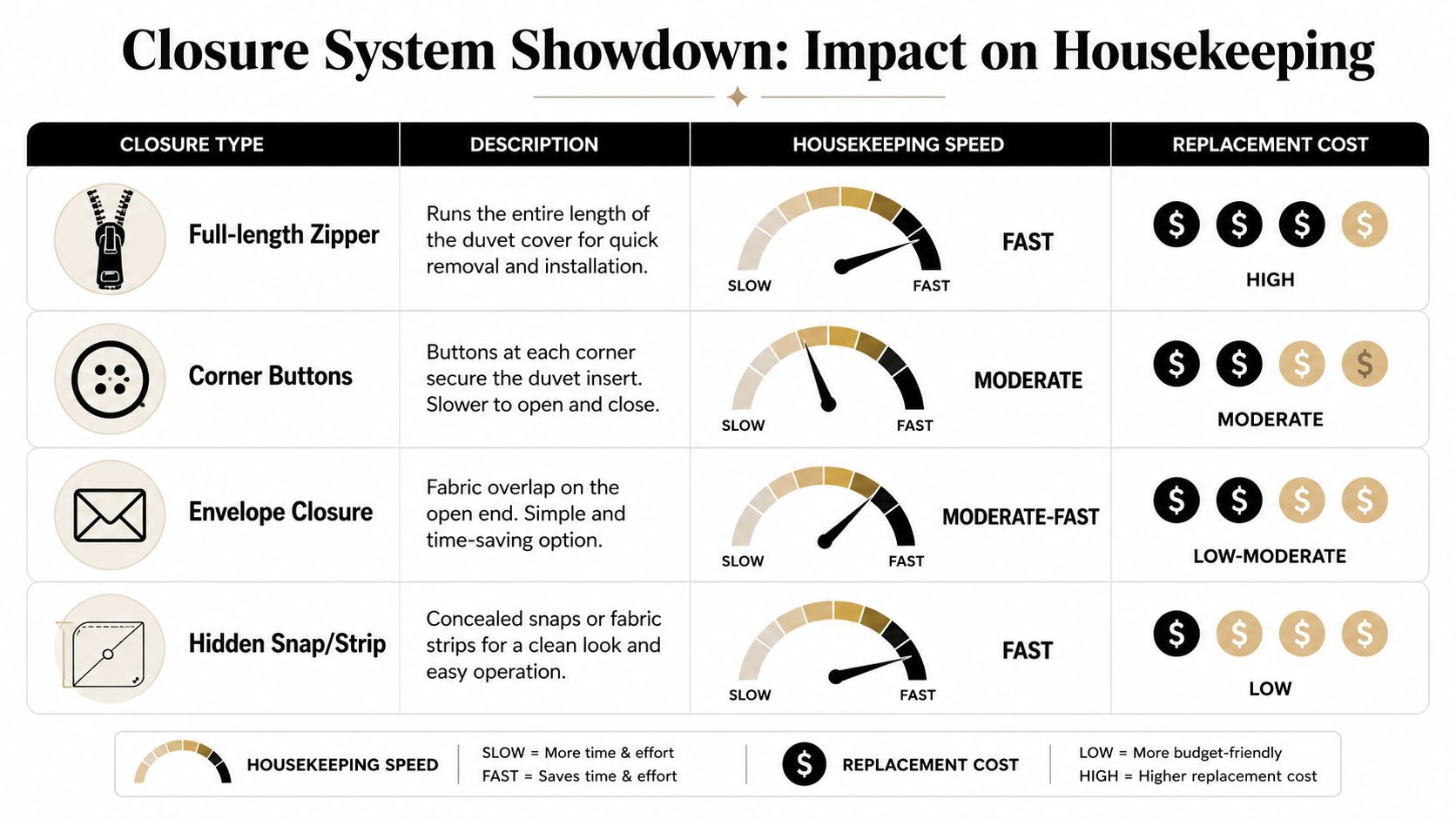
Closure choice sounds minor until housekeeping starts using the product every day. Then it becomes obvious that the closure system affects speed, durability, guest tampering risk, and replacement cost. In hotel operations, those details show up fast on the floor.
A full-length zipper usually gives housekeeping the quickest secure close, especially when teams are making beds at scale. It also helps the duvet stay aligned inside the cover, which reduces the odds of a sloppy-looking bed at check-in. The trade-off is that zippers can fail, and once they do, repair is rarely as simple as replacing a button.
Buttons, including corner buttons and more concealed button systems, can look more refined. Luxury properties sometimes accept the slower workflow because the finished presentation matters more than pure speed. The downside is that button loss and repair labor can become routine if the property pushes the covers hard through commercial laundering.
An envelope closure is simple and familiar, and in some operations it's preferred because it avoids hardware that can break. It can work well when the house team values low-friction handling over a tightly engineered seal. The weakness is that it's less secure than a zipper and can look less polished if the insert shifts.
A hidden snap or strip closure sits between appearance and function. It can preserve a cleaner look while still giving a more controlled opening than a plain envelope. That said, hidden systems can be harder to repair and may cost more to replace when the fastener fails, especially if the failure is sewn into a seam that sees constant stress.
The right closure depends on who's doing the bed making and how often. High-volume economy hotels usually care about speed and simplicity, so zipper or envelope systems often make more sense. Luxury properties may prefer hidden fasteners or buttoned finishes because the guest sees the bed before they see anything else.
The same operational thinking shows up across hospitality textile sourcing. The hospitality textile products market includes duvet covers as a standard room item, and the sourcing environment is shaped by large-scale manufacturing and regional supply concentration. That's why closure selection should be treated as an operational choice, not a style detail.
Here's a useful rule from the floor:
If staff have to wrestle with the closure during every room turn, the spec is wrong for that property.
Fit problems create visible mess fast. A duvet cover that's too tight pulls awkwardly across the bed, while one that's too loose makes the insert shift and bunch. Housekeeping notices first, but the guest sees it immediately.
The basic rule is simple, match the duvet cover to the actual insert size used in the property, then build in a little room for laundering movement. Cotton-rich fabrics can shrink, so procurement teams often allow 3% to 5% shrinkage tolerance in specifications when planning hotel bedding. That cushion helps prevent a cover from becoming unusable after repeated washing.
The practical move is to confirm the post-laundry fit before final rollout. Measure the insert, measure the finished cover, and check whether the closure closes without strain once the fabric has gone through a wash cycle. If the first sample looks good on the loading dock but distorts after laundering, it's not a valid spec.
Economy and business properties often standardize around a few core bed sizes so replacement is simple and room turns stay predictable. Boutique and luxury properties sometimes use non-standard inserts to achieve a specific drape or designer look, but those choices need tighter controls because custom sizing can complicate replenishment. The more unusual the bedding story, the more important it is to document exact finished dimensions.
A good quality-control checklist looks like this:
Confirm finished measurements: Check the cover after laundering, not just before purchase.
Verify insert compatibility: Make sure the duvet fill doesn't overstuff the cover or leave excess slack.
Inspect seam recovery: Watch how the corners and edges behave after handling.
Check replacement availability: Confirm that a re-order will match the same dimensions and closure spec.
The operational logic is the same whether the property is small or large. If housekeeping has to fight the product, the spec is costing more than the invoice suggests.
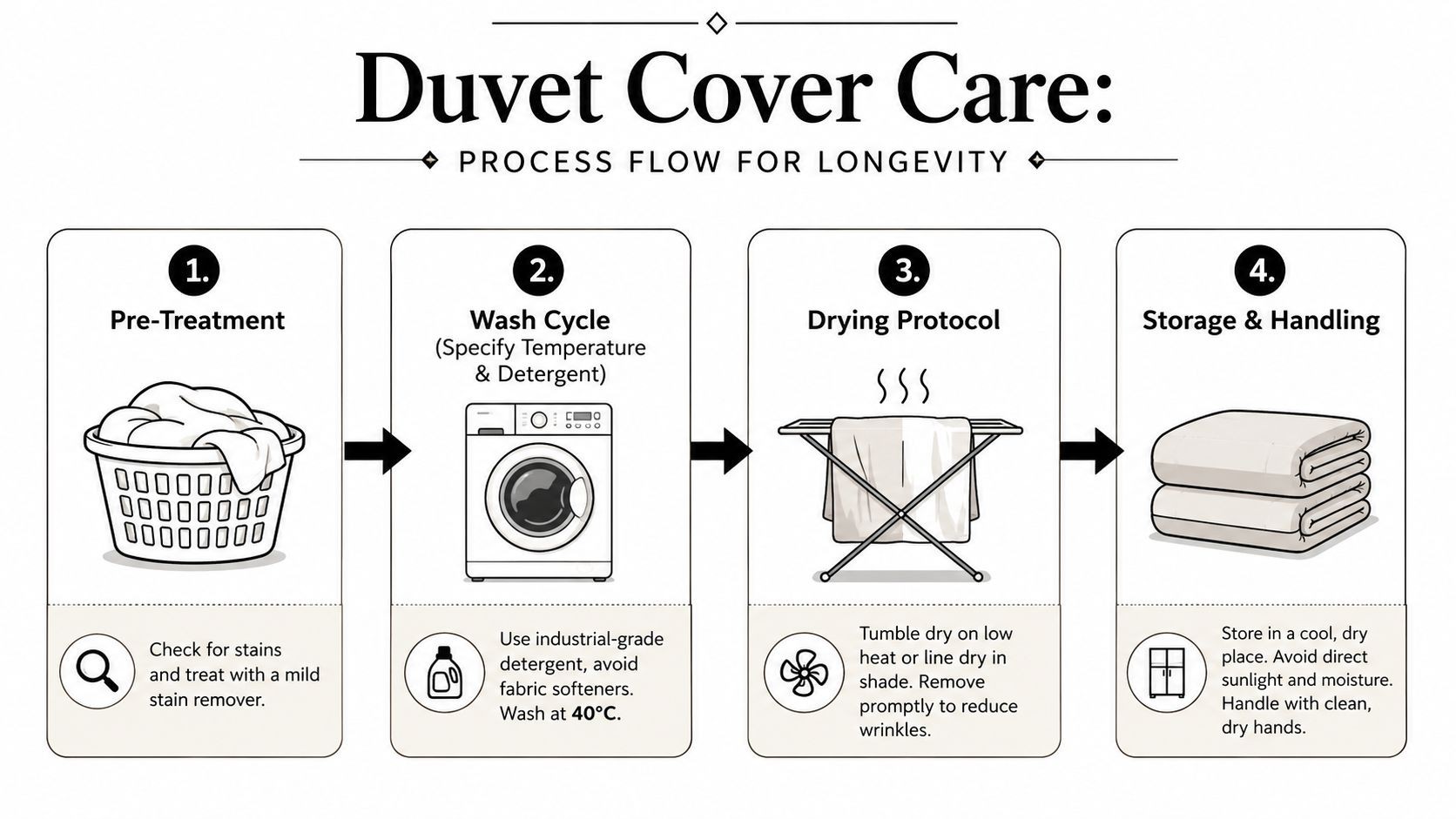
Most bedding wear is created in the laundry room, not at the guest bed. Fabric choice matters, but what the team does with heat, chemicals, and handling matters just as much. A cover that looks fine on day one can age badly if the process is rough.
Cotton-polyester blends generally tolerate harsher commercial laundering better than pure cotton because the polyester component helps stabilize the fabric. That's one reason they stay popular for hotels that need regular sanitation without constant replacement. Pure cotton can still be a strong choice, but it asks for more controlled handling to avoid premature wear.
The biggest mistakes are predictable. Too much heat can accelerate seam stress and visible wear. Harsh treatment can also worsen pilling, fading, and shape distortion over time. If a laundry program doesn't match the fabric construction, the product life drops no matter how good the sample looked.
Rotation is one of the simplest ways to protect budget. If the same covers cycle through the same rooms or same carts too often, the wear pattern becomes uneven and replacements arrive in clusters. A disciplined rotation system spreads the load and keeps the linen room from discovering a problem only after a large section of inventory is already tired.
For operators who want a practical care reference, this hotel bedding wash and care guide is a useful operational companion.
Operational insight: The cheapest cover on the purchase order can become the most expensive item in the laundry room if the care program and the fabric spec don't match.
Good procurement does not start with a generic claim of “hotel quality.” It starts with the room type, the turnover pace, and the laundry program behind the linen room. A duvet cover that works in a roadside property can be a poor fit for a luxury floor, and a spec that looks tidy on paper can create extra handling once housekeeping has to process it every day.
For economy properties, speed, durability, and easy laundry handling usually matter more than a refined hand-feel. A 50/50 cotton-polyester blend or another fabric that tolerates repeated commercial washing is often the safer choice because it is easier to process and less likely to create friction for housekeeping. An envelope closure or a simple zipper can also work well when room turns need to stay quick and the team cannot afford fiddly handling.
The purchase decision still needs to reflect real use, not just list price. Hotels in this tier usually benefit from specs that reduce sorting mistakes, resist rougher handling, and dry predictably. That is why a lower-friction fabric build often performs better in practice than a more delicate cover that looks good in a sample room but creates avoidable wear in the laundry cycle.
Mid-scale hotels usually need a more balanced specification. A 300 thread count cover in a cotton-rich blend often gives a workable mix of guest comfort, clean presentation, and laundry performance. Zipper closures fit this segment well because they speed housekeeping without leaving the bed looking unfinished.
Consistency matters more here than chasing a pure luxury feel. Properties with several room types need stable sizing, repeatable reordering, and fabric behavior that stays predictable after wash after wash. The team should also match the spec to the rest of the bedding package, which is why many operators review a 5-star hotel bedding collection for ideas on how covers, sheets, and inserts are coordinated in a premium setting without copying a spec that is too costly for their own operation.
Luxury hotels can justify a more refined hand-feel and a more deliberate finish. A higher-cotton cover, a cleaner closure detail, and tighter attention to drape all make sense when the bed is part of the brand story. The operating cost is higher, but so is the expectation that the room will look composed from the first turndown through the final inspection.
These properties often accept more careful laundry handling in exchange for presentation. That means the spec can prioritize a softer surface, better visual balance, and closer fit around the insert, as long as the housekeeping team can still process the items without slowing room readiness. The right choice depends on whether the brand is aiming for a polished guest impression, a lower repair burden, or both.
Resorts often prioritize comfort and visual calm, but they still need covers that hold up under frequent laundering and seasonal occupancy swings. Extended-stay properties may lean toward simpler, more durable specs because guests stay long enough to notice wear patterns and small inconsistencies in the bed. Eco-focused brands should judge durability and care efficiency alongside material sourcing, because a fabric that fails early is rarely a better environmental choice in actual use.
Operating model changes the spec as much as property type does. A resort with heavy weekend turnover needs a different cover than an extended-stay asset with slower room changeover and longer guest retention. The practical test is whether the fabric, closure, and size choice reduce linen room problems, hold their shape after repeated washing, and still present well after real housekeeping handling.
Procurement gets easier when the team stops shopping by price alone. The stronger approach is to evaluate suppliers for sample quality, lead times, customization, minimum order reality, and re-order consistency. A low unit cost doesn't help if the next shipment doesn't match the first one.
A hotel should define its bedding standard before sending requests for quote. That means specifying blend, thread count, closure type, finished dimensions, and laundering assumptions in one document. Once those specs are clear, it becomes much easier to compare suppliers on the things that matter.
Quality assurance should happen before the covers are everywhere in the property. Inspect samples, wash them, fit them to real inserts, and check how they perform after handling. If the product looks great on the sample table but loses shape in the laundry cycle, the procurement team needs to catch that before rollout.
Bulk purchasing can make sense when the property is standardizing across many rooms and wants consistent replacement inventory. Smaller or seasonal operators may need more flexible ordering because demand changes through the year. The smartest contracts leave room for that reality.
The best procurement teams also track how the covers perform in the field. Housekeeping feedback matters. So does how often repairs are needed, how well the closure holds, and whether the sizing stays consistent from batch to batch. That's the difference between buying linens and managing a bedding program.
If you're specifying duvet covers for hotels right now, East West Hotel Textile can support hotel bedding sourcing with duvet covers, sheet sets, and related room textiles built for hospitality operations. Visit East West Hotel Textile to review product lines and compare options against your property's laundry workflow, room-turn pace, and bedding standard.
Read More

The Whole List of All Three MICHELIN Key Hotels in 2026
Release date: 2026-10-07
EastWest Inside: Hotel Linen Manufacturing Process
Release date: 2026-09-21
Top Rated Pet-Friendly Hotels Around the World
Release date: 2026-09-08