


The Whole List of All Three MICHELIN Key Hotels in 2026
Release date: 2026-10-07Release Date: 2026-08-28 14:27:07
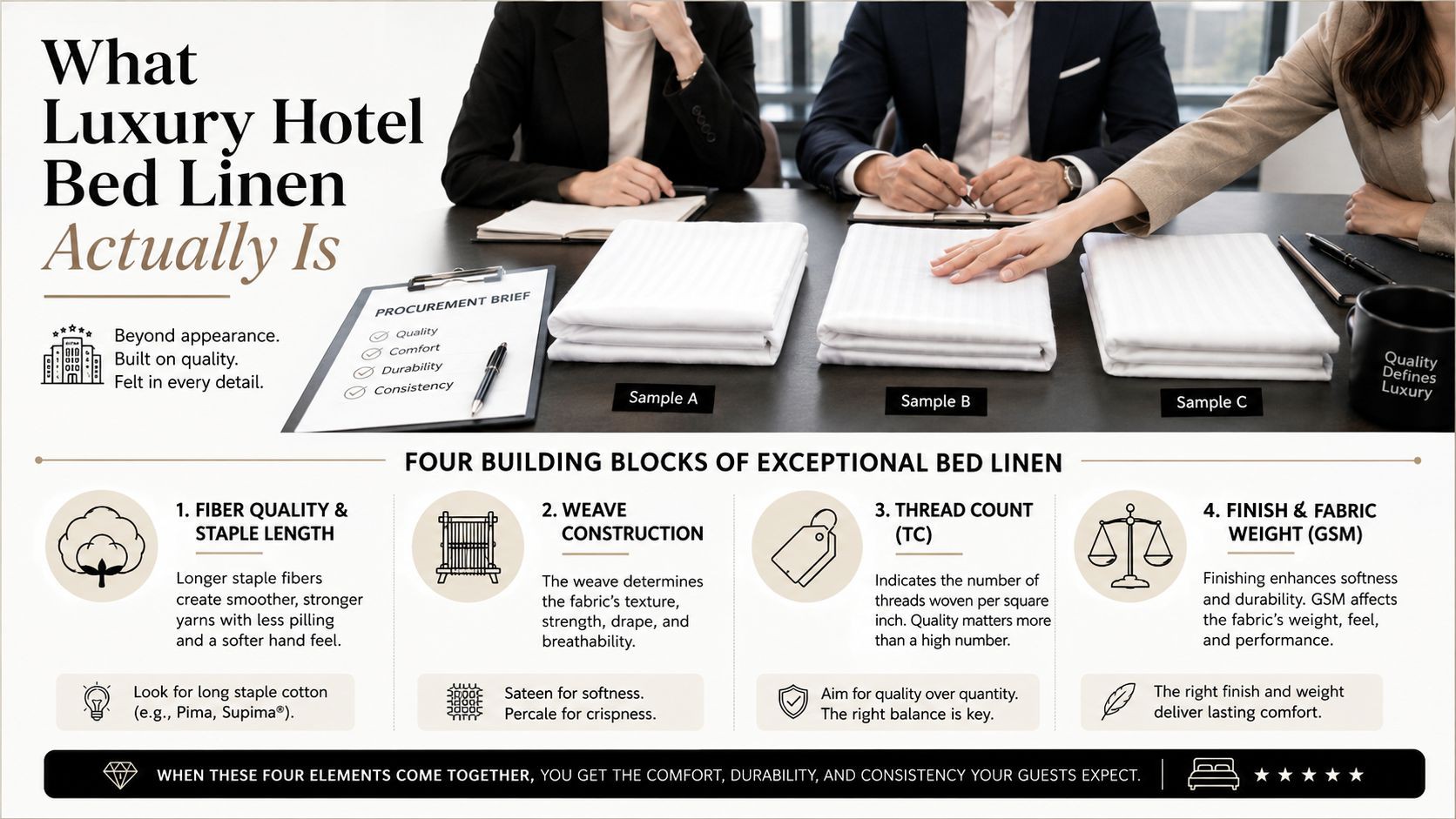
A procurement manager looking at three white samples should not ask, “Which one feels softest?” first. The better question is, “Which one is built to survive my laundry process, fit my mattress profile, and still feel consistent across every room?” Luxury hotel bed linen is a commercial specification, not a decor purchase, and that distinction changes how you judge every sample on the table.
The four building blocks are straightforward once you slow them down. Fiber is the raw cotton quality, yarn is how those fibers are spun, weave is how the yarns cross, and finish is the treatment that changes handfeel, sheen, shrinkage, and appearance. If any one of those is wrong, the sheet may look luxurious on day one and behave like a compromise after repeated laundering.
Practical rule: don't price a linen set until the supplier can tell you the fiber type, yarn construction, and finishing process in plain language.
Ask whether the sheet is built on single-ply yarn or a multi-ply construction, whether the cotton is long-staple, and what finishing steps were used. Then ask how the set is expected to perform under commercial wash conditions, because hotel bedding wears out fast in real operations. Solenis notes that commercial hotel bed linen typically lasts only 100 to 150 wash cycles, which often means replacement every 12 to 24 months depending on the property's linen quality, occupancy, and wash process, and linen replacement alone can represent nearly one-third of total laundry operating costs.
That cost reality is why luxury hotel bed linen sits inside a broader procurement system. Grand View Research places the global luxury bedroom linen market at USD 4.73 billion in 2024, with commercial settings accounting for 52% of sales in 2024, and the market is projected to reach USD 7.45 billion by 2030 at an 8.0% CAGR from 2025 to 2030 (Grand View Research). In other words, hotels and resorts are not a side market, they're the center of demand.
The easiest way to understand yarn quality is to compare a bundle of broom straws with a bundle of silk threads. Short fibers behave more like the broom straws, they create more loose ends, more friction, and more weakness under repeated stress. Longer fibers behave more like silk threads, they can be spun into smoother yarns that hold together better in a hotel laundry cycle.
Single-ply yarn means one yarn strand is used instead of twisting multiple plies together. In hospitality, that matters because multi-ply construction can make a sheet look heavier on paper without necessarily making it more durable in service. A technically sound hospitality specification is single-ply long-staple cotton at roughly 300 to 400 TC for premium percale or 350 TC for premium sateen, paired with measurable performance targets such as 120 to 155 GSM, Grade 4 to 5 colorfastness, and 200 to 300+ wash cycles.
That range gives you a clue about what matters most. The spec is not chasing a huge thread-count headline, it's balancing fabric weight, wash resilience, and surface quality. For a new procurement manager, that means a supplier's fiber story should be specific. “100% cotton” is not enough if the cotton is short-staple and the yarn construction won't hold up.
If you're comparing sheets by touch alone, the best sample can still fool you. A smooth first impression may come from finishing, not from durable fiber quality. That's why luxury hotel bed linen needs a fiber conversation before you ever compare price per set.
Use this internal benchmark when you're reviewing hospitality-style cotton sheets: 100% cotton bed sheet constructions often look similar at first glance, but the useful difference is whether the yarn, weave, and finish are set up for commercial laundering.
Procurement insight: the longer the fiber and the cleaner the yarn, the less the sheet has to rely on marketing language to feel premium.
Thread count is a real measurement, but it's still only one measurement. It tells you how many yarns sit in a square inch, not whether those yarns are strong, whether the weave breathes well, or whether the finish will stay stable after repeated pressing and washing. That's why a round-number claim can mislead you if you treat it like a quality grade.
For luxury hotel bed linen, the most common specification is 300 to 400 thread count in a sateen weave. Ultra-luxury properties often over 400 thread count using Egyptian or extra-long-staple cotton with a mercerized finish, because higher-quality long fibers and tighter finishing improve smoothness, drape, and sheen without relying on inflated thread-count numbers that don't always improve handfeel or durability.
That range matters because it shows how thread count is tied to fiber quality and finish, not just a bigger number. A well-made lower-count sheet can feel better in a hotel than a dense sheet built from weaker yarns. In commercial use, the better question is whether the fabric gives the right balance of guest comfort, pressing behavior, and laundry resilience.
| Thread Count | Typical Tier | Recommended Fiber | Common Weave |
|---|---|---|---|
| 200 to 300 | Premium hotel | Long-staple cotton | Percale or sateen |
| 300 to 400 | Luxury hotel | Long-staple or extra-long-staple cotton | Sateen |
| 400 to 1000 | Ultra-luxury hotel | Egyptian or extra-long-staple cotton | Sateen |
A 250 TC long-staple percale can outperform a much denser multi-ply sheet if the hotel values crispness, breathability, and wash durability. The reason is simple, more yarns don't automatically mean better service life. The structure underneath the label matters more than the printed number.
Practical rule: if the supplier leads with thread count and can't explain yarn construction, the spec is incomplete.
Percale and sateen are the two weave decisions that most clearly change guest perception. Percale feels like a freshly pressed cotton shirt, crisp and cool. Sateen feels closer to a softly brushed dress shirt, smoother, drapier, and a little warmer against the skin. Once you've felt both in a hotel room, the difference is obvious.
Percale is the safer choice when the brand wants a crisp, matte, airy feel. It suits warm climates, flagship properties, and rooms where the guest experience is built around freshness and simplicity. Sateen gives a silkier, lustrous look and often suits suites, boutique hotels, and cooler settings where the bedding is supposed to feel more cocooning.
The laundry room also treats them differently. Percale tends to keep a straightforward hotel look after pressing because its surface stays less glossy and more structured. Sateen gives a more polished visual effect at first, but the sheen can make wear patterns easier to notice over time if the fiber and finish are weak.
The cleanest rule of thumb is this. Choose percale when your brand promise is freshness, breathability, and a classic hospitality look. Choose sateen when your brand is selling softness, drape, and visual richness. Neither one is “more luxurious” in every setting; they produce different guest responses.
Here's a useful internal reference point for hospitality purchasing: Percale and sateen comparison for hotel sheets. It helps frame the decision around feel and service model, not just label language.
Finishing is the point where a soft showroom sample becomes a hotel product that can survive repeat use, or where it starts to fail after the first demanding laundry cycle. The main processes are pre-shrinking, singeing, mercerizing, and calendering. Each one changes how the sheet behaves in use, and each one matters more in a hotel than it does in a retail bedroom.
Pre-shrinking limits how much the fabric moves after washing, so fit and dimensions stay closer to spec. Singeing removes surface fuzz, which gives the cloth a cleaner look and helps reduce pilling. Mercerizing changes the cotton structure so it feels stronger, takes dye more evenly, and carries a more refined sheen, which is why it is often chosen for higher-end hotel programs. Calendering runs the fabric through rollers to flatten the surface, creating a smoother, more pressed appearance.
A hotel spec should not treat these finishes as isolated labels. It should ask which combinations hold up under industrial laundering and which ones lose their effect quickly. A sheet can look polished in a sample room, then lose shape or surface quality after repeated hot washes if the finish was chosen for appearance rather than service life.
The earlier specification targets, 120 to 155 GSM, Grade 4 to 5 colorfastness, and 250 to 300+ wash cycles, give procurement teams a practical frame for judging whether the finish is built for commercial use. Those numbers are the bridge between textile language and how the linen behaves in an operating hotel.
Operational rule: a finish only matters if housekeeping can still press, fold, and remake the bed without fighting the fabric.
In a luxury hotel, the right finish should keep the sheet crisp, help it resist pilling, and hold the surface steady after laundering. If the handfeel comes mainly from a heavy coating or a temporary surface treatment, that effect usually disappears quickly in service. Ask the supplier how the fabric was finished, then ask what happens after repeated commercial wash cycles. That second question usually tells you whether the spec is built for daily use or just for a good sample.
A linen spec sheet means very little if the hotel can't turn rooms efficiently. The best fabric in the world still fails if the property can't rotate enough clean sets through laundry, storage, and guest-ready staging. That's why par planning belongs in the same conversation as yarn and weave.
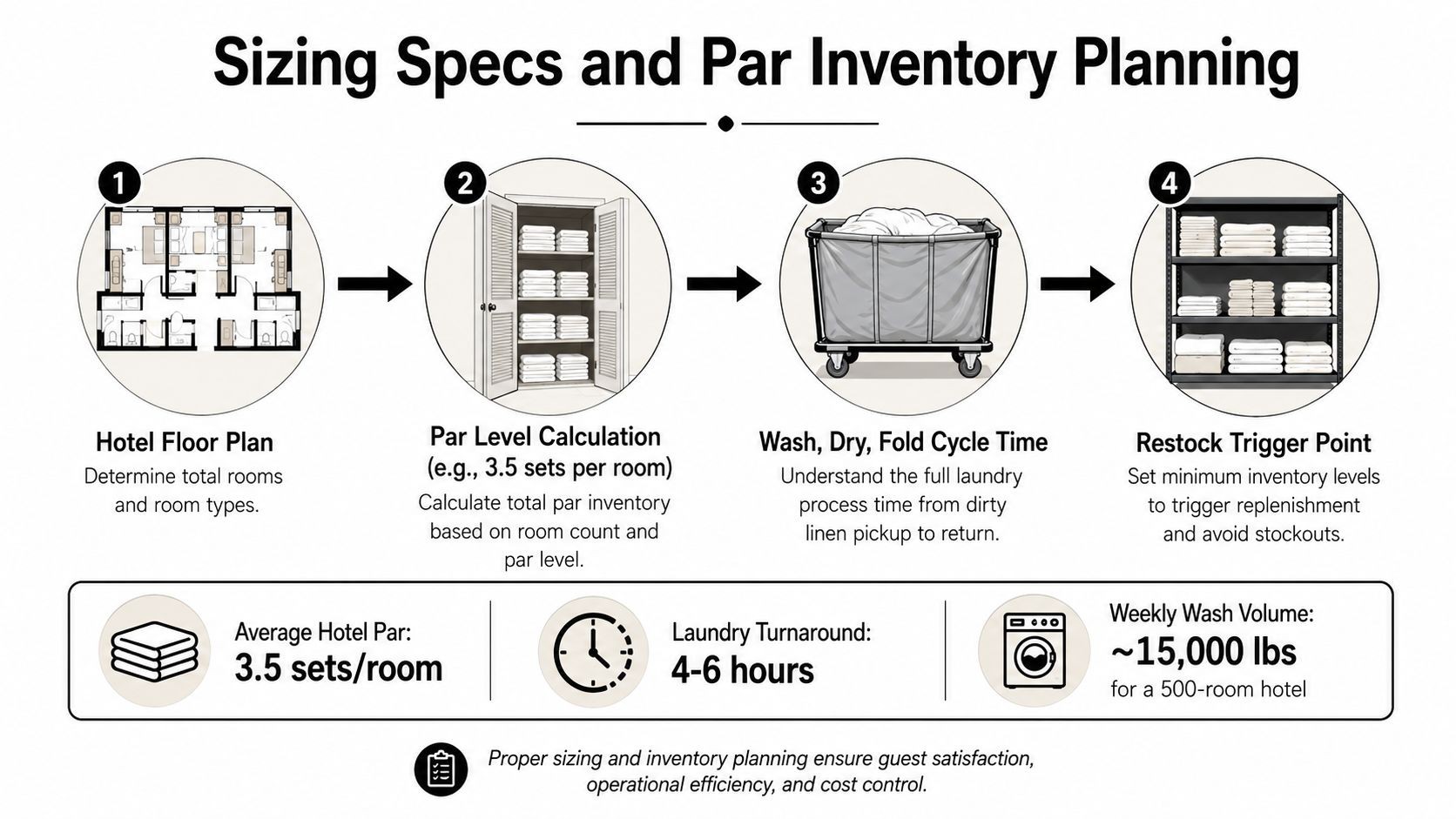
Hospitality guidance commonly uses a par level of 3.5 for in-house laundry and 4.5 when laundry is outsourced, which shows how closely linen planning is tied to turnaround and logistics. That means the same bed linen spec can require a very different starting inventory depending on where the washing happens and how quickly the property can put clean stock back into circulation.
The short version is this. More par protects the operation, but it also raises holding cost and replacement exposure. Less par lowers stock on hand, but it can make room readiness fragile when housekeeping gets hit by a surge in occupancy or laundry delay.
Use the fiber and finish targets from the earlier sections, then attach them to the room count and laundry model. That gives you a clearer procurement picture than “we need luxury sheets.” It also helps you think about replacement cadence, which matters because commercial linen life is short and replacement is a major operating expense.
For a 500-room hotel, weekly wash volume can be substantial in practice, so the number of sets in circulation must be planned against the laundry rhythm, not against a catalog photo. The moment you see bedding as inventory flow, not décor, the ordering logic becomes much clearer.
A clean specification reads like a working instruction, not a mood board. For a five-star urban hotel, the document should name the exact sheet dimensions, mattress pocket depth, weave, fiber type, GSM target, finishing steps, colorfastness target, shrinkage tolerance, and the minimum wash-cycle expectation. Without those items, every sample review becomes subjective.
A practical brief might ask for single-ply long-staple cotton, a weave chosen for the brand position, a defined GSM range, and a finish suited to commercial laundering. It should also state whether the property wants a crisp matte appearance or a smoother, more lustrous one. That keeps the mill from filling gaps with assumptions.
A hospitality supplier such as East West Hotel Textile can be evaluated the same way you'd evaluate any manufacturer, by how clearly it translates brand standards into a production-ready item list. The point isn't the logo on the catalog, it's whether the company can work from a usable brief and deliver consistent bedding across a property.
Your sample request should include:
Sheet dimensions: flat, fitted, and pillowcase sizes matched to the mattress profile.
Fabric targets: thread count band, weave type, and GSM.
Finish requirements: pre-shrunk, singed, mercerized, or calendered, as needed.
Performance targets: colorfastness, shrinkage tolerance, and wash-cycle expectations.
Packaging and labeling: room category identification, carton counts, and inventory coding.
That approach makes supplier comparison easier because each candidate answers the same brief. It also makes rollout easier, since operations, laundry, and housekeeping can all work from the same spec sheet.
The quickest way to keep a linen purchase grounded is to force every sample through the same checklist. If a supplier can't answer these points cleanly, the spec isn't ready.
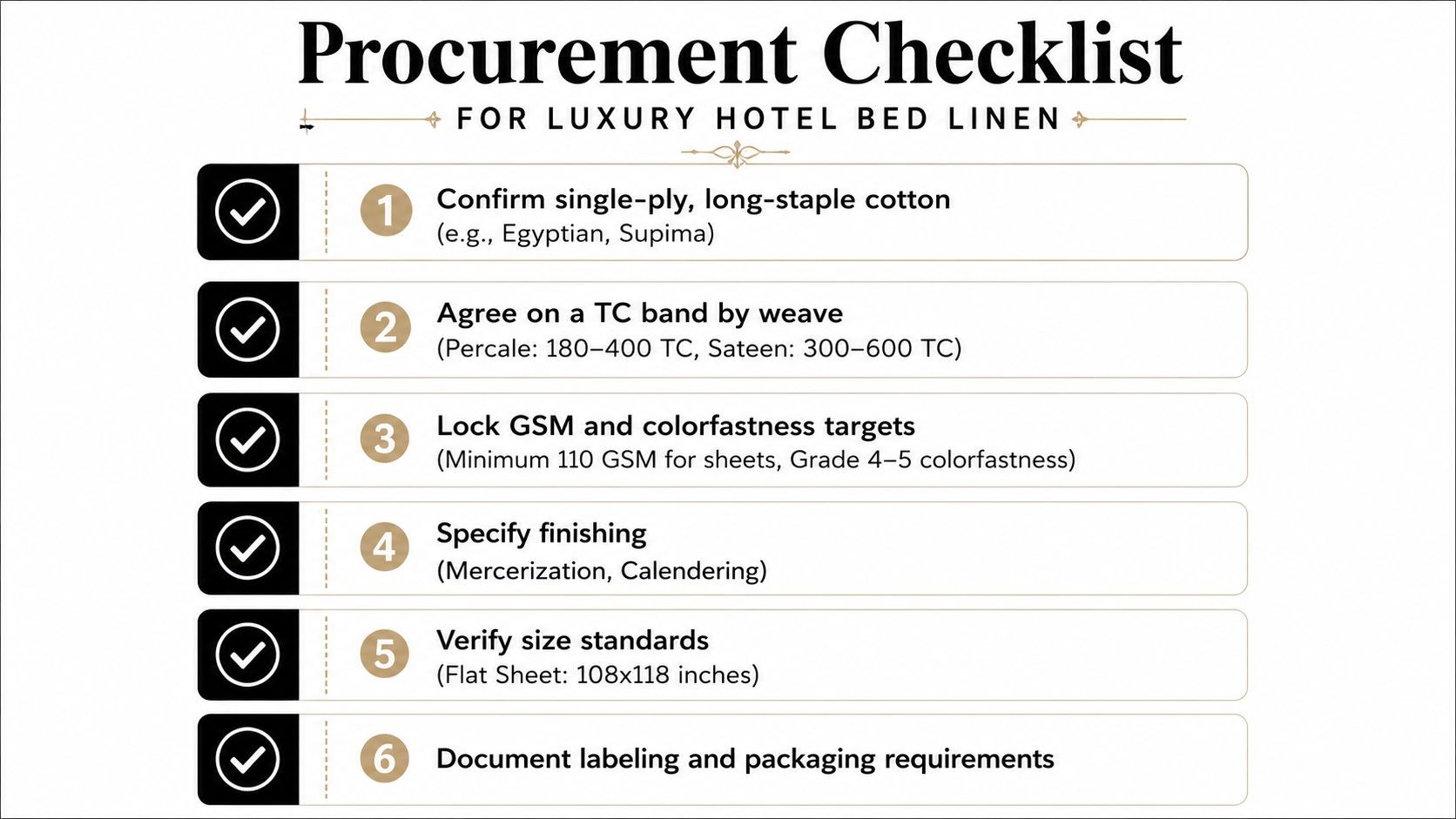
Confirm fiber construction: ask for single-ply, long-staple cotton and identify whether the cotton is Egyptian, Supima, or another long-staple source.
Lock the weave and TC band: set the thread-count target by weave, because percale and sateen behave differently in service.
Specify finish and wash performance: require the finishing steps you need, plus clear shrinkage and colorfastness expectations.
Check dimensions against the room model: fitted sheet depth, flat sheet overhang, and pillowcase sizing all have to match the mattress profile.
Test under laundry conditions: don't judge only by showroom feel, look at how the sample responds after timed wash and press cycles.
Align par and replacement planning: the linen program should fit the laundry model, storage space, and budget cycle, not just the room design.
If you want luxury hotel bed linen that earns its keep, treat it like an engineered supply item. East West Hotel Textile can help you source hotel bedding and related hospitality textiles, and the right next step is to visit East West Hotel Textile with your room specs, laundry setup, and target feel in hand. Bring the checklist, ask for samples that match your operation, and compare the results after a real wash cycle, not just in the meeting room.
Read More

The Whole List of All Three MICHELIN Key Hotels in 2026
Release date: 2026-10-07
EastWest Inside: Hotel Linen Manufacturing Process
Release date: 2026-09-21
Top Rated Pet-Friendly Hotels Around the World
Release date: 2026-09-08