


The Whole List of All Three MICHELIN Key Hotels in 2026
Release date: 2026-10-07Release Date: 2026-08-25 17:34:16
You're probably staring at a stack of towel quotes that all look the same. One supplier says “premium,” another says “hotel grade,” and a third sends a sample that feels plush but leaves you guessing whether it'll survive your laundry room, your occupancy pattern, or your replacement cycle. That's the trap with hotel towels bulk buying, the catalogs talk about softness, but the property lives or dies on spec, volume, and laundering reality.
The right brief starts with your operating model, not the price sheet. A smart buyer works backward from guest tier, turnaround time, and total cost of ownership, then matches GSM, size, and par levels to the actual property. That's how you stop buying towels that look good in a swatch book and fail in the wash.
A procurement manager asks for hotel towels bulk pricing, and the quotes come back impossible to compare. One supplier prices a thin economy towel, another sends a plush spa spec, and a third switches the size. The buying team ends up comparing unit price instead of the operating cost of the towel program.
That is the wrong starting point. Towels are a long-life consumable, and quality hotel towels can last about 150 to 200 washings. Hotels may also lose roughly 10% to 20% of inventory per month through wear, loss, and damage, as noted by North Hospitality Services. Buy on price alone and the savings disappear fast, because you pay for them later in quicker replacement cycles, heavier laundry loads, and more front-desk shortages.
A towel quote without GSM, size, and room count is just a number. If the property tier and laundry model are not defined first, suppliers fill in the blanks for you, and they usually fill them in with whatever helps their margin. A serious brief states what the hotel is, what the guest should feel, and what the laundry room can handle.
The spec also has to cover quality markers that buyers can see and feel. East West Hotel Textile's guide to high-quality hotel towels is useful here because it shows how construction details shape the towel a guest gets. GSM tells you density and weight, while pile, weave, and yarn type affect absorbency, drying time, and how the towel holds up after repeated laundering.
| Bulk Hotel Towel Specification Reference | What It Measures | Operational Impact |
|---|---|---|
| GSM | Fabric density and weight | Higher GSM feels plusher, but dries more slowly and adds laundry burden |
| Pile | The surface loops of the towel | Deeper pile often feels softer, while flatter pile can dry faster |
| Weave | How the yarn is constructed | Terry is the standard for absorbency, waffle changes drying behavior |
| Size | Bath, hand, face, and mat dimensions | Size affects guest comfort, room presentation, and washer loading |
Sizing causes another layer of confusion. Bath towels, hand towels, face towels or washcloths, and bath mats are not interchangeable, and a quote that mixes them tells you the supplier is not working from your use case. A clean brief ties the towel mix to room type, guest expectations, and laundry capacity. That is how procurement stops being a price check and starts matching the spec to the way the property runs.
Towel quotes are full of terms that look technical but aren't hard once you translate them into operations. GSM is the first one to learn. It stands for grams per square meter, and it tells you how dense and heavy the towel is. Higher GSM usually means a thicker, more absorbent towel, but it also means more drying time and more weight in the laundry room.
Think of GSM as the towel's engine size. A bigger engine can deliver a stronger guest experience, but it also consumes more fuel. That's why the towel that feels luxurious on a sample table can become annoying in a commercial wash cycle. The construction matters too, because pile, weave, and yarn type shape how the towel performs after repeated laundering.
| Bulk Hotel Towel Specification Reference | What It Measures | Operational Impact |
|---|---|---|
| GSM | Fabric density and weight | Higher GSM feels plusher, but dries more slowly and adds laundry burden |
| Pile | The surface loops of the towel | Deeper pile often feels softer, while flatter pile can dry faster |
| Weave | How the yarn is constructed | Terry is the standard for absorbency, waffle changes drying behavior |
| Size | Bath, hand, face, and mat dimensions | Size affects guest comfort, room presentation, and washer loading |
The other practical source of confusion is sizing. Bath towels, hand towels, face towels or washcloths, and bath mats are not interchangeable, even when a quote sheet makes them look that way. If you want a clear breakdown of construction features, the supplier note on high-quality hotel towel features is worth reading alongside the spec sheet.
A bath towel affects guest comfort most directly. A hand towel changes bathroom presentation and day-to-day turnover. Washcloths get used hardest and disappear fastest, so they need a different stocking mindset than bath towels. When you understand those distinctions, you stop treating the towel program like one item and start treating it like a set of linked consumables.
That mindset matters. The hotel doesn't buy a towel in isolation. It buys a system that has to survive use, heat, transport, and replacement planning.
A property that buys every towel like it is outfitting a luxury resort will waste money fast. Budget, mid-range, upscale, and spa operations do not have the same guest expectations, laundry systems, or replacement pressures. One flat spec ignores all three, and procurement pays for that mistake later.
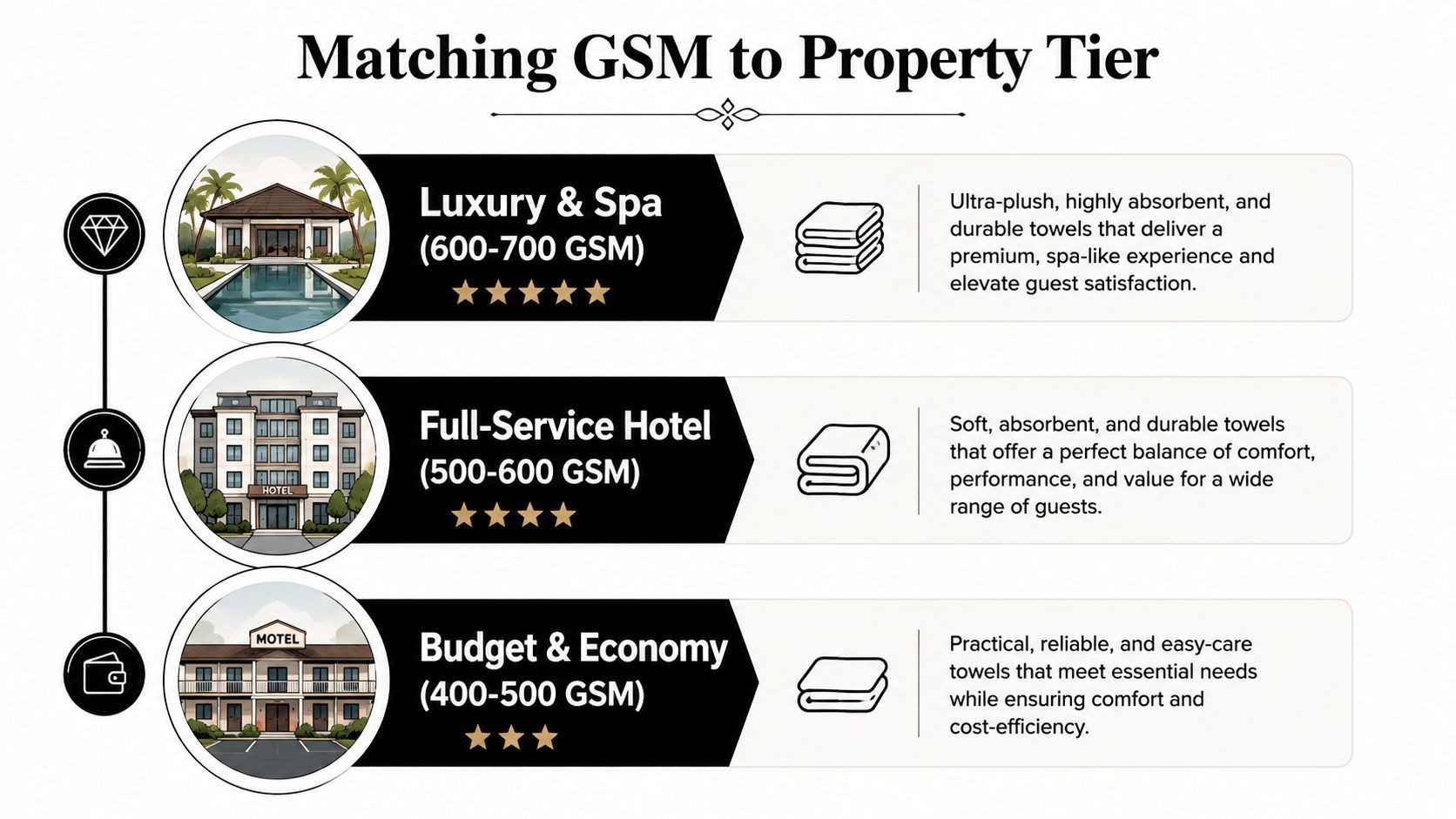
A wholesale guide places budget properties at 400 to 500 GSM, mid-range at 500 to 600 GSM, upscale at 600 to 700 GSM, and luxury or spa at 700 to 900 GSM. That range is useful because it reflects both the guest experience and the way housekeeping has to move stock through the laundry. A heavier towel can feel more premium, but it is a poor choice if it slows turnover or strains the wash program.
The operational logic is straightforward.
Budget and economy: use 400 to 500 GSM. These properties need faster drying, simpler turnaround, and cleaner replacement economics.
Full-service and mid-range: stay in 500 to 600 GSM. That range gives a better hand-feel without choking laundry throughput.
Upscale: choose 600 to 700 GSM. Guests notice the difference here, and the towel should feel richer in the room.
Luxury and spa: specify 700 to 900 GSM only when the service model can support it. Plushness matters, but so does laundry burden.
A practical wholesale guide recommends stocking 4 to 6 bath towels, 4 to 6 hand towels, and 8 to 12 washcloths per room to cover laundry cycles and spares. The washcloth number runs higher because those items are small, used often, and more likely to vanish in circulation. Bath towels move more slowly, so disciplined operations can run a tighter replacement buffer there.
Operational truth: the right towel assortment is defined by laundry survival and room-turn standards, not by visual appeal. It has to hold up through wash cycles, staff handling, and replacement planning without forcing emergency reorders.
Organic cotton belongs in the discussion too, but only when the guest segment will notice it or the brand story supports it. If the property sits in economy or lower mid-scale, paying for a certification story that guests will not perceive is usually a bad trade. Save the higher-spec cotton for properties where the bathroom experience is part of the value proposition.
They underbuy. They count rooms, multiply by a rough guess, and call it a day. That approach ignores laundry turnaround, shrinkage, and the fact that towels do not stay in circulation forever. The result is a thin stockroom and too many urgent reorders.
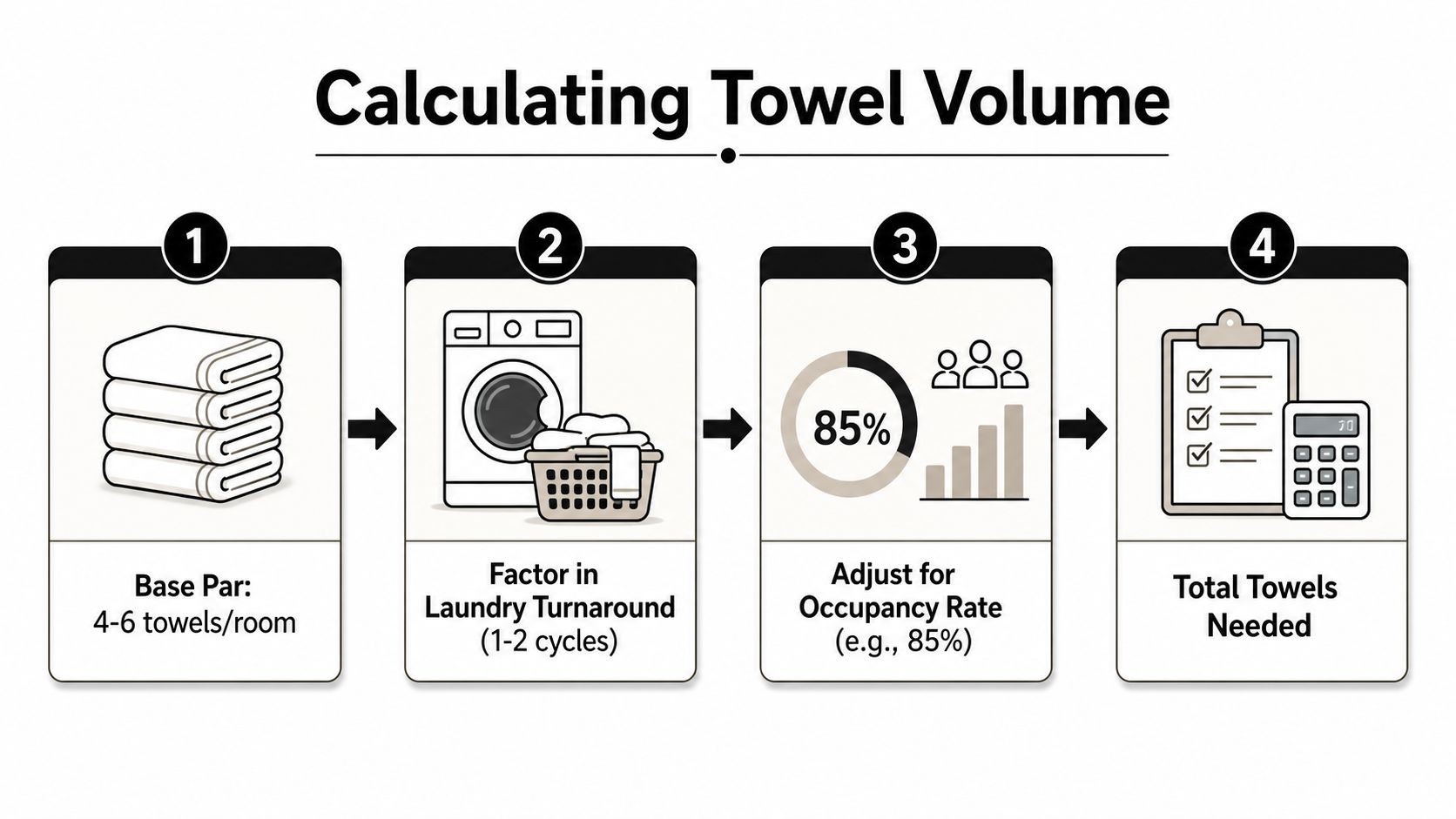
A common par level is 4 to 6 towels per room. That is the base layer. From there, you add the impact of laundry turnaround and occupancy swings. A 100-room hotel with one-day laundry turnaround may need about 500 to 700 towels in total, depending on the service model and buffer strategy.
The logic is simple:
Set the room par. Decide how many usable towels each room should have on hand.
Add laundry cycle coverage. One-day or multi-day turnaround changes how many spares you need.
Buffer for occupancy. High occupancy means more towels in use at once.
Add replacement stock. Inventory loss is real, so do not pretend every piece stays in circulation.
Recommended laundering conditions still lead to 4% to 10% shrinkage. That matters because a towel that looks fine on the purchase order can come out smaller after wash cycles. If you buy just enough on paper, shrinkage turns usable inventory into a shortage.
A smarter buyer adds buffer before the order is placed, not after the first complaint. That buffer is not waste. It keeps housekeeping from running short during a busy stretch or a laundry disruption.
Use this sequence for your own property:
Room count multiplied by room par
Adjusted for laundry turnaround
Adjusted for expected occupancy
Adjusted for shrinkage and loss
For sizing and weight choices that support this math, see East West Hotel Textile's towel size and weight guide. Procurement teams that skip those adjustments end up guessing at replenishment, and guessing is expensive. The quote in front of you only works if it covers the actual operating rhythm of the building.
A buyer who keeps pushing up the GSM number is usually solving for the wrong problem. In some properties, thicker towels make sense. In many others, they strain laundry throughput, eat storage space, and raise replacement friction without giving guests enough extra value to justify the cost. A shift from 500 to 600 GSM should follow guest expectations and service targets, not status chasing or a vague sense that thicker means better.
Heavier towels take longer to dry and move more slowly through commercial laundry equipment. They also cost more to ship because each piece carries more weight. That becomes a real problem in fast-turnover hotels, conference properties, and resort operations where the laundry room already runs near capacity.
A towel still has a finite service life. As noted earlier, the industry guidance puts a good towel at 150 to 200 washings. If the towel is too heavy for your operation, the extra plushness does not pay back the added drag on drying, handling, and replacement. You spend more to move it, more to dry it, and more to keep the program supplied, without getting a matching guest benefit.
Mid-GSM towels usually fit better when the priority is speed. They are easier on dryers, easier on staff, and less punishing when you are managing large inventory counts. That does not make them a compromise. It makes them the right fit for the laundry system that exists.
Use the East West Hotel Textile guide on choosing towel size and weight as a spec check when you are balancing guest feel against handling. The point is not to buy the thickest towel on the page. The point is to buy the towel your property can turn, store, and replace without creating bottlenecks.
If a supplier keeps pushing the heaviest towel in the line, ask what that choice does to drying time, storage density, and replacement cycle. If they cannot answer in operational terms, they are selling texture, not a working towel program.
Good towel buying starts with samples and ends with paperwork. Anything in between is where mistakes creep in. The risk isn't just picking the wrong towel. It's approving a product that looks right, then discovering later that the warehouse can't hold the order, the lead time is too vague, or the replacement terms are nonexistent.
Ask for swatches before you commit. Confirm minimum order quantities against actual storage space. Ask for lead time in clear terms, not “soon” or “standard.” Then pin down the details that keep the relationship from turning into a front-desk problem.
A proper purchase order should lock down:
GSM tolerance
Dimensional tolerance after wash
Color consistency across dye lots
Replacement terms for defective units
Certification documentation if you need organic or OEKO-TEX support
If a vendor says a towel is organic or certified, ask for the paperwork. If the towel is supposed to meet a brand standard, get the construction details in writing. That includes stitch quality, hem finish, and fiber blend. A towel program fails when the samples are beautiful and the shipment is inconsistent.
Buyers get burned when they treat a towel quote like a commodity purchase. It isn't. It's a recurring operating asset.
That's why negotiation should focus on total program quality, not just the per-piece number. A cheaper towel with inconsistent dye lots, weak hems, or unclear replacement terms can cost more once it hits circulation. In procurement, the red flag is not a higher price. It's a supplier who avoids specifics.
East West Hotel Textile is one option in this category. It supplies hotel bath linen and related hospitality textiles, including bath towels, hand towels, face towels or washcloths, and bath mats, so it fits into a broader linen sourcing conversation when a property wants one vendor across categories.
A usable buying brief has four parts. First, define the property tier. Second, select the GSM band that matches the laundry model. Third, calculate the towel count with shrinkage and loss built in. Fourth, request quotes against that spec, not the other way around. That sequence keeps the buyer in control.
A 120-room mid-range hotel with on-premise laundry usually needs a different program than a 120-room conference hotel with outsourced laundry, even though both start from the same search term, hotel towels bulk. The first can often manage a little more weight if the laundry team is efficient. The second may need a towel that dries faster and circulates more cleanly through a third-party system.
The buyer's brief is the product. The supplier is just the source. If you get the brief right, the quote comparison gets easier, the samples make more sense, and the reorders stop surprising you. For a broader towel assortment reference, the hotel towels category is a practical place to compare formats once the spec is clear.
Plan around the wash-life guidance already noted, not around optimism. Towels wear faster when laundry chemistry is harsh, heat is excessive, or drying is careless. If the pile flattens, hems fray, or the towel feels thin after repeated cycles, it's already telling you it's nearing retirement.
Most of the loss is wear and tear, not theft. Hotels should track missing pieces, damaged pieces, and rooms returned with incomplete linen counts as separate operational issues. A clean inventory process tells you whether the problem is guest use, housekeeping handling, or poor replenishment control.
I wouldn't. Mixed suppliers create inconsistencies in hand-feel, shade, and size after wash, and those differences show up in the guest room. If you need a backup source, keep the spec identical and treat the second supplier as a contingency, not a parallel program.
Use it where the guest story or brand standard supports it. If the property tier doesn't reward the upgrade, the added cost often becomes a procurement vanity metric instead of a guest-facing improvement. Keep the program aligned with what the room type can justify.
If you want a towel program that fits your room tier, laundry setup, and reorder cycle, talk to East West Hotel Textile and compare towel specs against your actual operating brief. Visit East West Hotel Textile to review hospitality textile options, request a quote, and build a bulk towel order that's sized for your property instead of guessed from a catalog.
Read More

The Whole List of All Three MICHELIN Key Hotels in 2026
Release date: 2026-10-07
EastWest Inside: Hotel Linen Manufacturing Process
Release date: 2026-09-21
Top Rated Pet-Friendly Hotels Around the World
Release date: 2026-09-08