


The Whole List of All Three MICHELIN Key Hotels in 2026
Release date: 2026-10-07Release Date: 2026-08-19 13:58:40
You're standing in a room with three competing pressures: the owner wants the beds to look more upscale, housekeeping wants faster turnarounds, and purchasing wants a spec that won't fall apart after a brutal laundry cycle. That's where hotel comforter sets stop being a décor decision and become a procurement decision. If you buy them like a retail shopper, you'll miss the variables that determine whether the set works in a hotel.
The right spec starts with the pieces in the set, then moves to fill behavior, sizing, laundering, and compliance. It also has to match the property class, because what works in a resort suite is usually a bad fit for a mid-scale roadside property. The market scale behind hotel bedding keeps that in perspective, too, with one forecast putting the broader category at $11.36 billion in 2025 and $16.12 billion by 2030, while another projects $12.8 billion in 2025 and $16.8 billion by 2034 The Business Research Company hotel bedding market report.
Buyers often think they're ordering one item, then discover they've approved a coordinated room-facing package. A proper hotel comforter set is built to standardize the bed's look, reduce presentation drift across rooms, and make housekeeping faster when the pieces are specified correctly.
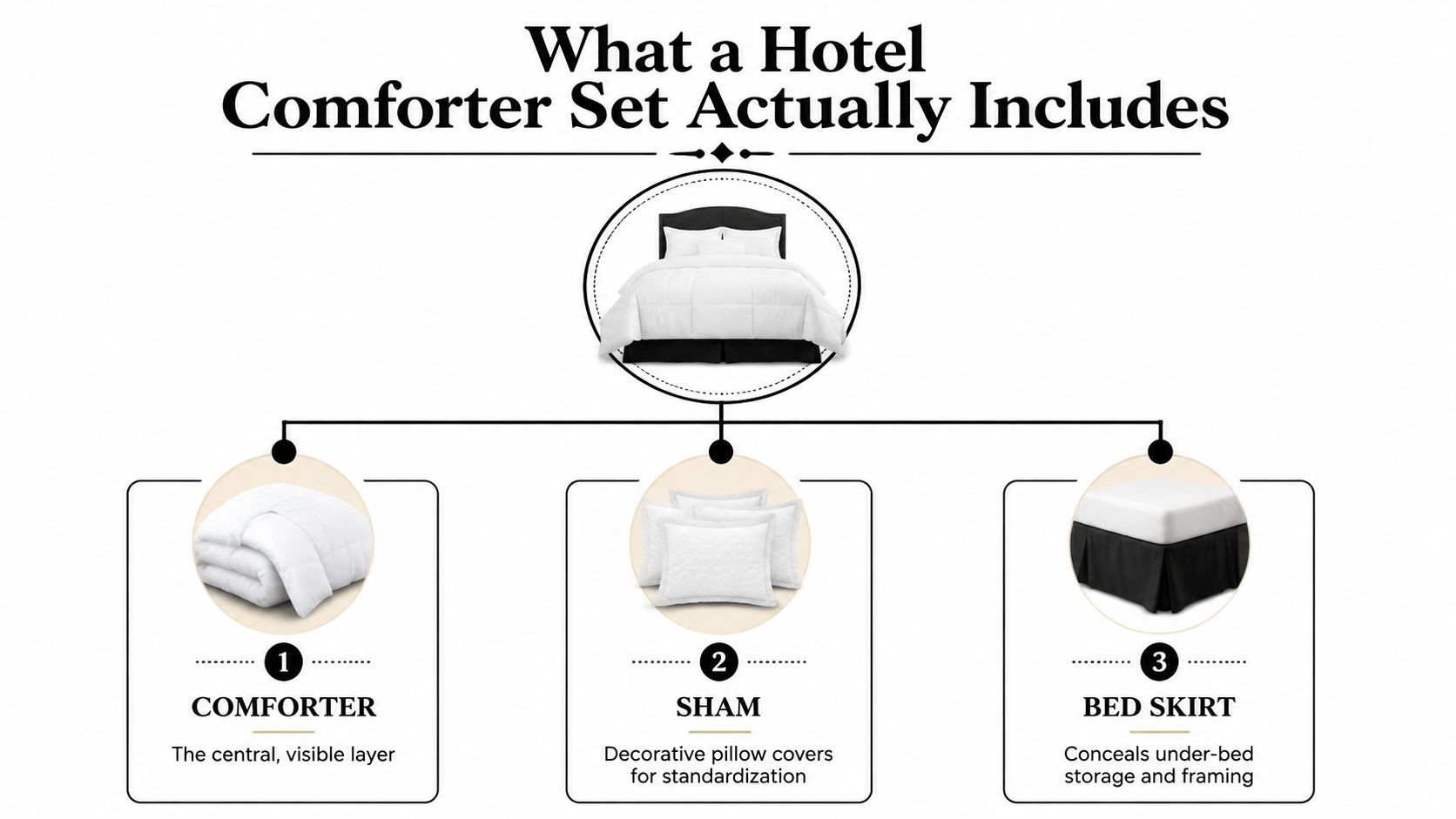
The comforter is the visual anchor. It covers the sleep surface, sets the room's first impression, and carries most of the guest's tactile judgment about warmth and softness. In hotel use, it also has to tolerate repeated laundering and hold its shape after it's been pressed, folded, and rotated through inventory.
The shams are not decorative afterthoughts. They're the quickest way to make the bed read as intentional rather than improvised, because they standardize the pillow presentation from room to room. In a chain environment, that matters almost as much as the comforter itself, since uneven pillow styling makes a guest notice the room instead of the bed.
The bed skirt handles the part of the bed guests shouldn't see, which makes it more important than it sounds. It conceals under-bed storage, frames the mattress, and hides the mechanical clutter that's common in real hotel rooms. A bed that looks polished at the top but sloppy at the base usually signals weak specification discipline.
Practical rule: order the three pieces as a system, not as separate decorative items. If one component is off in color, drop, or texture, the whole room looks less finished.
Optional add-ons such as decorative pillows, runners, and coverlets can extend the presentation, but they shouldn't replace a clear core spec. Too many extras create housekeeping friction, more SKUs, and more chances for mismatched inventory. In procurement terms, simplicity usually wins unless the brand standards absolutely require a layered show bed.
Fill choice is where the operating cost hides. A comforter can look luxurious on day one, then become a laundry problem, a replacement problem, or a guest complaint once it starts moving through the property's wash program. Commercial hospitality comforters are commonly expected to tolerate 200 to 350 wash cycles, with shrinkage targets of ≤3% in both warp and weft after multiple washes contract hospitality laundering guidance.
Goose down and feather deliver the most premium hand-feel. They're light, lofty, and efficient at trapping warmth, which is why they still show up in upper-tier properties. The trade-off is laundry sensitivity. They need gentler wash conditions and complete low-heat drying, or they'll clump and hold moisture in ways housekeeping can't ignore.
Duck down and feather sit in a similar category, though they're usually positioned as a more accessible natural-fill option. Operationally, they still share the same basic constraint, which is that fill quality doesn't matter much if the laundry program punishes the cluster structure. Buyers who choose feather blends should be honest about their drying capacity and turnaround time.
Down-alternative microfiber or hollowfiber is the practical answer for many hotels, especially where quick-turn laundering matters. Synthetic fill dries faster and stays more stable under routine commercial wash programs. If you want a product example to compare construction and fill language, see this down-alternative comforter specification.
Buyer's shorthand: if laundry capacity is tight, synthetic fill usually gives you fewer surprises. If brand positioning depends on a softer, more luxurious hand, natural down can work, but only when housekeeping can protect it.
Allergy policy can settle the issue before comfort does. In some properties, the question isn't which fill feels nicer, it's which fill lets you maintain a consistent guest policy without extra front-desk friction. That's why fill selection belongs in procurement, not in décor review.
Cost per room follows the same logic. A lower unit price isn't a saving if the fill breaks down early, dries slowly, or forces extra labor. For hotel comforter sets, the cheapest purchase is often the most expensive operating decision.
Sizing is where good intentions get exposed. A set can have the right color and fill, but if the drop is wrong or the shams don't match the pillow profile, the bed reads as off. Hotels don't buy a “queen look” or a “king look,” they buy dimensions that behave correctly on the actual mattress stack.
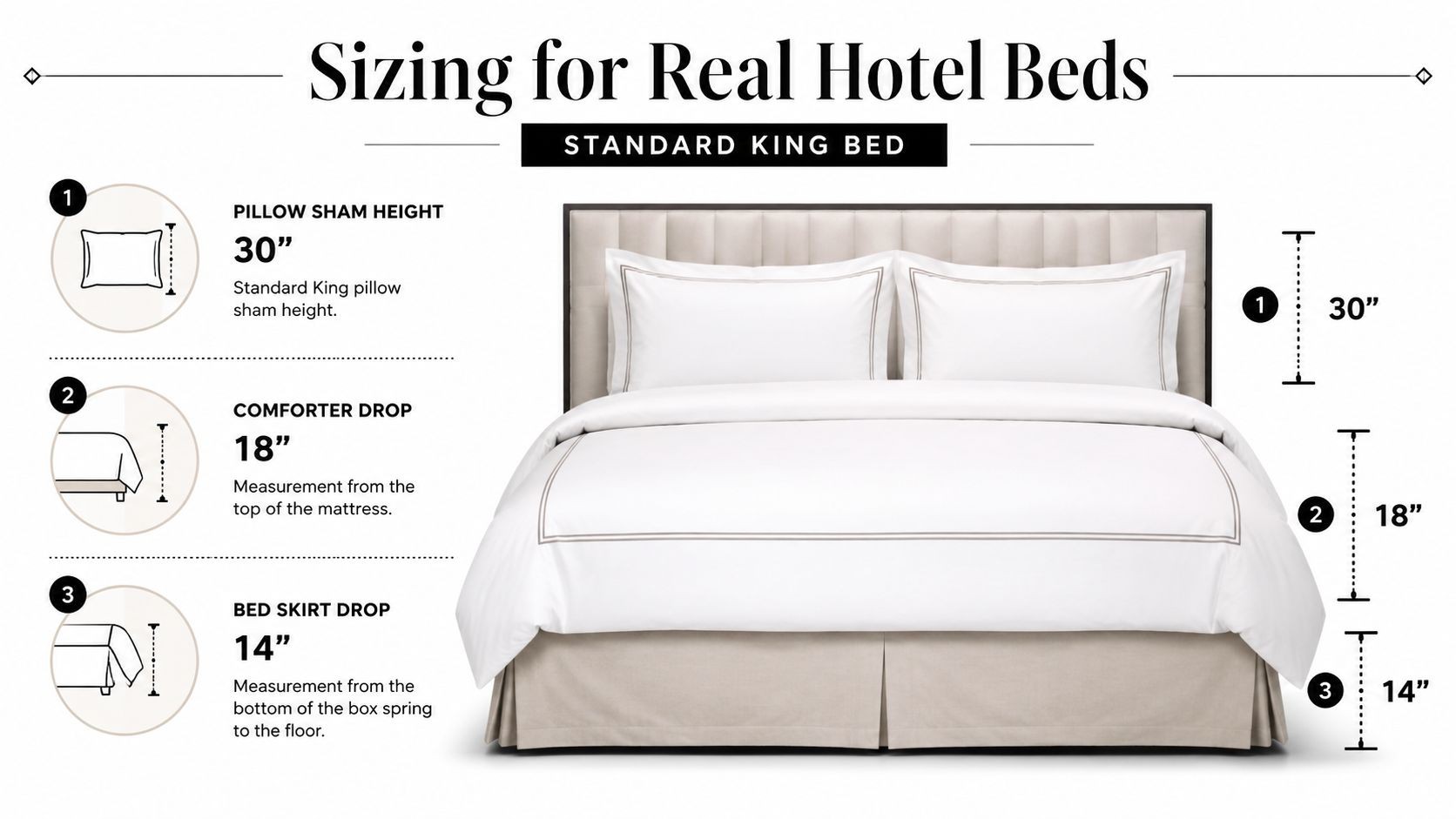
The comforter should cover the mattress and box spring visually without dragging the floor. That sounds obvious until a property uses a thicker mattress topper or a taller base, then the same comforter suddenly looks short. When you spec it, think in terms of how far the fabric falls, not just the label size on the carton.
Shams are selected to match the pillow profile the property uses. A standard hotel pillow arrangement usually needs the sham to hold structure at the head of the bed, not slouch inward after one night of use. If the sham is too loose, the bed looks tired before housekeeping has even left the room.
The bed skirt needs to reach the floor line cleanly. Too short, and the under-bed space shows. Too long, and it bunches, traps dust, or gets caught during cleaning. A fitted drop usually looks more disciplined, while a longer drape can work if the room style calls for a more traditional presentation.
For mattress and bedding coordination, this bedding-for-mattress guide is a useful reference point when you're aligning topper thickness, sheet depth, and comforter drop.
A “queen set” is only useful if the components are graded against the same room spec. A comforter that fits a queen bed can still look wrong if the shams are sized for a thicker pillow or the skirt is cut for a shorter base. That's why property managers should ask suppliers for the full dimensional set, not just the headline bed size.
A luxury resort, a mid-scale business hotel, and an economy property may all order hotel comforter sets, yet their operating requirements differ. Luxury properties sell a stronger sense of indulgence. Mid-scale hotels balance presentation with room turnover. Economy properties prioritize a clean, uniform bed at a manageable operating cost.
| Property Class | Shell Fabric | Fill Weight (Twin) | Presentation Detail |
|---|---|---|---|
| Luxury | Softer, finer shell with a more refined finish | Heavier, more plush build | Fuller drape, cleaner quilting, coordinated sham styling |
| Mid-scale | Durable shell that still looks crisp after repeated use | Moderate fill that balances warmth and washability | Simple, standardized finish with consistent room-to-room appearance |
| Economy | Hard-wearing shell selected for frequent laundering | Lighter, practical fill | Minimal decorative detailing, straightforward construction |
Luxury specifications can support higher spending on shell hand-feel, fill loft retention, and sham finishing. Guests notice these surfaces immediately, while a fuller bed presentation supports the room's price positioning. The skirt also deserves closer control, since a loose or uneven finish can make an otherwise polished room appear neglected.
Mid-scale hotels should direct budget toward consistency, recovery after laundering, and replacement availability. A comforter that still looks clean after repeated processing has more operating value than one that feels unusually plush during its first week. Quilting should hold the fill in place and maintain an even surface, rather than serving only as decoration.
Economy properties need components that can be processed, rotated, and replaced without complicated handling. Decorative trim adds failure points and rarely improves the guest experience enough to justify them. If the laundry cannot support delicate procedures, specify a practical shell, stable construction, and a fill weight suited to routine washing.
Useful buying habit: spend where guests can see or feel the difference, and save where laundering removes that difference.
Regional demand also influences the standards suppliers build around. The hotel bedding market is concentrated in major travel economies, with North America identified as the largest region in one forecast and Asia Pacific receiving the largest revenue share in another. These patterns reflect purchasing requirements from large, repeat-use hospitality markets rather than one-off retail preferences. For a property manager, the practical lesson is to compare a set's shell, fill, construction, and care requirements against the property's class and laundry capacity before approving the visual design.
A comforter set doesn't perform alone. It sits inside a layered bed system, and that system determines whether the room looks crisp at turndown or sloppy after the first guest sits down. Hotels that get this right use the top layers to protect the fill, simplify housekeeping, and create a presentation that stays consistent.
The duvet cover protects the insert from body oils and stains, which is why many laundering programs treat it as the removable, more frequently washed layer. The comforter or insert underneath can then rotate less often, which reduces handling on the housekeeping side. That separation is one reason hotel beds stay visually fresh even when the internal fill isn't being washed every time.
Decorative runners and cushion pieces extend the room's identity across the foot of the bed. They're useful when the property wants a more designed, upscale look, but they shouldn't crowd the core sleep function. If guests have to move three objects just to get into bed, the styling has gone too far.
Shams signal the room's style before the guest even opens the closet. A pair of well-stuffed shams communicates order. Flat, sagging shams do the opposite. That's why some properties keep several sham fills in rotation, even when they don't change the comforter itself.
The laundering reality matters here, too. Recent care guidance notes that down and down-alternative comforters can be washed, but only in large-capacity machines and with long drying times to avoid mildew and clumping hotel comforter washing guidance. That's a workflow issue, not a design preference.
A layered bed works when housekeeping can remake it fast and consistently. Every added accent has to justify the labor it creates. If the room can't be reset cleanly across all shifts, the presentation system is too complicated for the property class.
A comforter set only looks cheap until it starts moving through the laundry room. Then the true cost shows up in replacement frequency, labor, and compliance headaches. That's why procurement teams need to read beyond softness and look at the construction that survives actual hotel use.
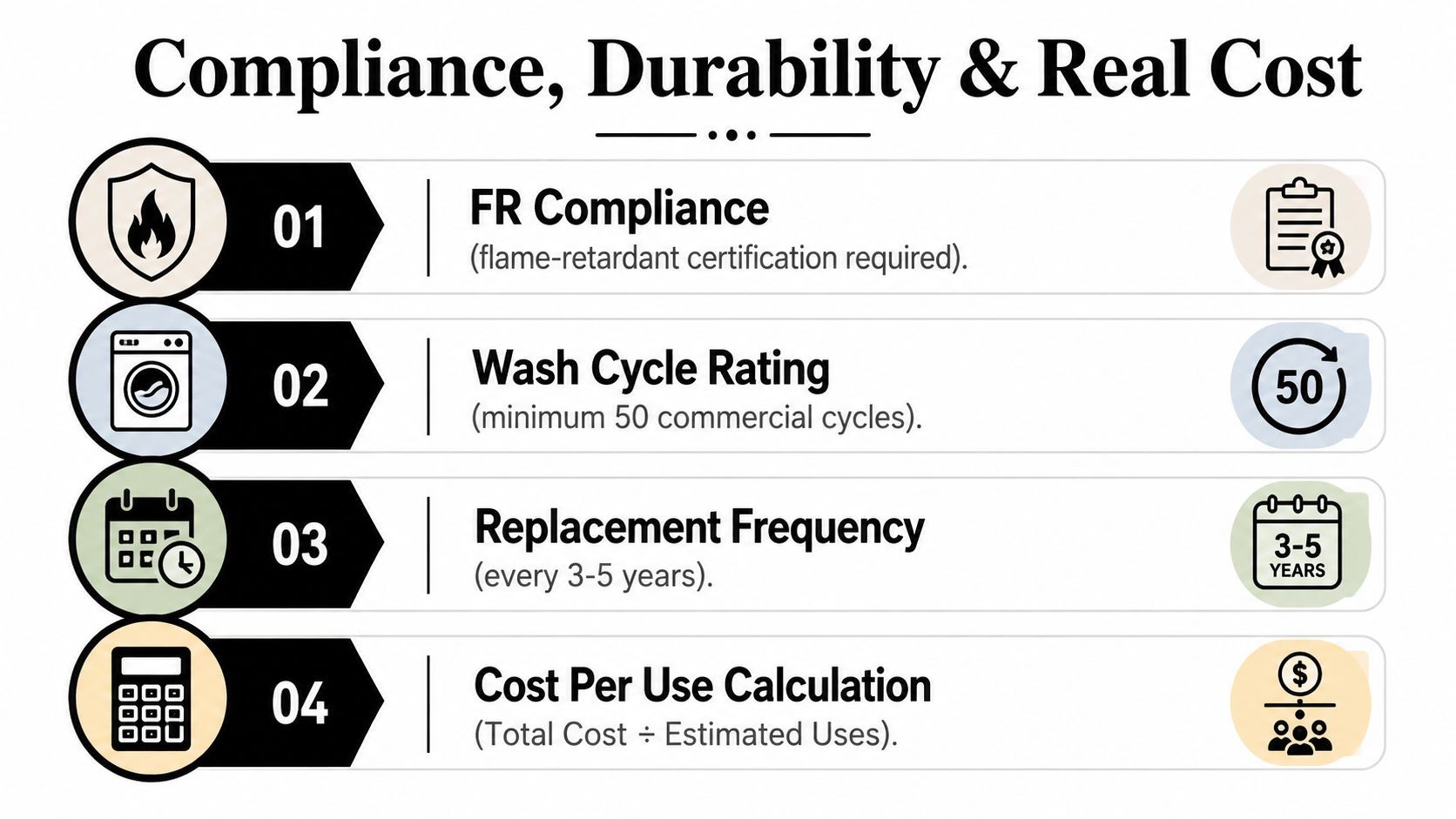
Commercial hospitality bedding is built around repeated wash cycles, not showroom handling. Independent care guidance suggests hotel-grade bedding can be expected to withstand roughly 200 to 300 wash cycles when maintained properly, and commercial-grade linen that survives 150+ industrial washes reduces replacement waste, water use, and chemicals 2026 bedding trend coverage. The point is simple, a set that fails early is rarely a bargain.
Fire safety is the other hard boundary. Canada's Textile Flammability Regulations require bedding without a raised fibre surface to have a flame-spread time greater than 7 seconds, and European and UK hospitality purchasing commonly references EN 1021-1, BS 7175, BS 7176, and BS 7177 test frameworks for ignition resistance Canada Textile Flammability Regulations. The practical takeaway is that the assembled comforter set has to be considered as a system, including shell, quilting, fill, and any decorative outer layers.
Sustainability doesn't start with a marketing claim. It starts with whether the item lasts long enough to avoid early disposal. A comforter that survives more laundering uses fewer replacement resources over time, while a fragile set shifts costs into waste, water, chemicals, and labor.
For care routines and maintenance discipline, this hotel bedding care guide is worth keeping in the purchasing file. It helps align procurement specs with the actual laundry process, which is where so many bedding decisions succeed or fail.
Procurement reality: the lowest purchase price can still be the highest lifetime cost if the set can't survive the wash program.
A usable spec sheet is short, direct, and tied to the property's operating reality. Start with shell fabric, fill type, fill weight, and the exact dimensions for the comforter, shams, and skirt. Then add key requirements, including commercial wash tolerance, fire-safety compliance, and shrinkage expectations.
The trap is buying on thread count alone. Thread count can be part of the picture, but it doesn't tell you whether the set will hold loft, survive laundering, or pass institutional use requirements. If a quote looks good but doesn't state the fill system, the wash profile, or the construction details, it's not a real hotel spec.
A good buyer's checklist should ask three questions before price even enters the conversation. Will housekeeping be able to wash it the way the property operates. Will the set still look right after repeated use. Does it match the brand positioning of the property, not someone else's catalog photo.
East West Hotel Textile supplies hotel bedding, duvets, pillows, and related guestroom textiles for properties that need coordinated specifications across bed and bath categories. If you're narrowing down a comforter set for your own property, visit East West Hotel Textile and compare the construction options against your laundry capacity, room class, and compliance requirements.
Read More

The Whole List of All Three MICHELIN Key Hotels in 2026
Release date: 2026-10-07
EastWest Inside: Hotel Linen Manufacturing Process
Release date: 2026-09-21
Top Rated Pet-Friendly Hotels Around the World
Release date: 2026-09-08