


The Whole List of All Three MICHELIN Key Hotels in 2026
Release date: 2026-10-07Release Date: 2026-08-22 17:01:54
Most advice about a hotel amenities kit starts from the wrong assumption. It treats more items as a better guest experience, even though hotels end up paying for visibility, not usage. A tighter kit, built around what guests touch and take, usually does a better job of protecting margin and keeping housekeeping simple.
That shift matters because the amenity category is not small. The global hotel amenities market was valued at USD 7.8 billion in 2024 and is projected to reach USD 14.2 billion by 2033, with a 6.9% CAGR over the period, while toiletries accounted for more than 28% of total revenue in 2024. In other words, amenity decisions sit inside a large consumables market, not a decorative side expense. North America held about 34% of global share in 2024, which helps explain why sourcing discipline matters in major hotel markets.
The easiest mistake is stocking for optics. Operators add extra items because they look premium in photos or feel generous on a spec sheet, then the room turns over with most of those items untouched. The Boston University hospitality study makes that gap hard to ignore, because it shows that guest expectations and actual use don't line up neatly across common amenities.
Some items are clearly more dependable than others. In that study, auto check-in was used by less than 2% of guests, while physical amenities such as bath robes showed large positive expectation gaps, with one comparison reporting 64% and another 88% over expectation. Packaged soap sat close to expectation at roughly 4% difference in one segment, which is a useful signal for procurement teams, because it suggests guests care most when a basic, tangible item is missing or cheapened.
Practical rule: if an item is low-use and high-visibility, it often belongs in a branded presentation decision, not in every room pack.
That's why bloated amenity kits usually underperform. They spread budget across low-value extras and leave less room for the things guests notice during a stay. The same research also showed measurable usage and expectation gaps for practical items like iron and ironing boards and hair dryers, which is the right reminder that utility matters more than promotional flair.
A smarter kit strategy starts with a shortlist of essentials, then asks a blunt question about every add-on: will the guest use it in this room type, on this length of stay, and in this property tier? If the answer is “rarely,” it should be a candidate for removal, relocation, or made available on request instead of sitting in every pack.
A restrained assortment also helps housekeeping. Fewer SKUs mean fewer replenishment errors, cleaner count controls, and less waste when inventory drifts. The challenge isn't to eliminate generosity, it's to direct it toward items that create a real stay-quality impression.
That's especially true when a kit is treated as a fixed bundle across all rooms. The same toiletries and accessories won't make sense for every hotel class, or every guest profile. The hotels that do this well use the kit as a controlled utility item first, then layer in brand expression only where the extra cost is defensible.
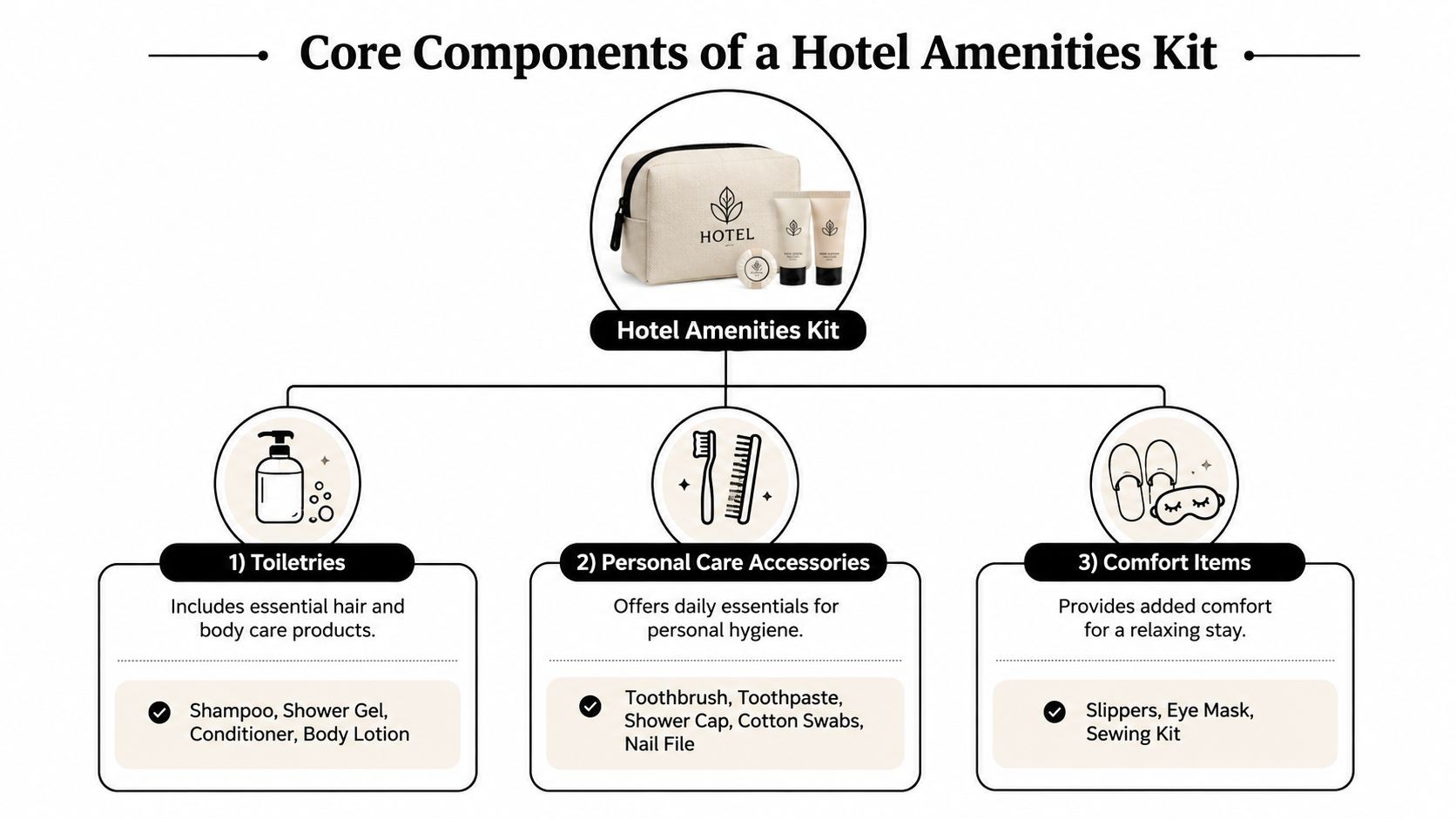
A useful hotel amenities kit usually falls into three buckets, toiletries, personal care accessories, and comfort items. The exact mix should reflect room type and stay pattern, but the basic logic stays the same, give guests the items they're most likely to reach for on arrival, before they have to call the front desk.
Shampoo, shower gel, conditioner, body lotion, and soap are the core of the kit because they solve the most immediate guest need. These are the items that connect directly to bathing and grooming, so they're the hardest to leave out without degrading the experience. The Boston University study's usage-versus-expectation tables also reinforce the point that tangible, routine items matter more than decorative extras.
A practical sourcing detail is packaging format. One market example specifies a vanity kit with 2 cotton pads, 4 cotton swabs, and 1 floss pick, plus cotton pads around 2.3 to 2.4 inches and swabs around 3 inches long. Those dimensions matter because they affect how well the kit nests into a box, how easily housekeeping can replenish it, and how much shelf space is lost to unused air.
Compact, individually wrapped parts often feel more hygienic to guests and make warehouse packing more predictable.
Toothbrush and toothpaste sets, shower caps, combs, shaving kits, vanity kits, cotton swabs, and nail files all live in the “nice to have, sometimes essential” category. These items work best when they're standardized and easy to count. Individually wrapped components help here because they improve hygiene perception, reduce mix-ups, and keep carton density high for housekeeping.
For operators choosing a baseline amenity basket, a practical reference point is the bathroom amenities category used by suppliers such as East West Supplies' bathroom amenities for hotels. The value isn't in copying a catalog item by item. It's in using a defined parts list to keep procurement disciplined.
Slippers, eye masks, sewing kits, and bathrobes are comfort-led items, not universal necessities. They earn their place when the property type or guest profile supports the spend. A resort, long-stay boutique, or luxury floor may justify them. A budget property often won't.
The cleanest way to think about this category is simple, essentials first, accessories second, comfort items only when the room rate and brand promise can carry them.
A hotel amenity kit shouldn't look the same in a roadside economy property and a high-touch resort. Guests don't arrive with identical expectations, and the length of stay, housekeeping cadence, and brand story all change what feels appropriate. Matching the kit to the tier keeps the product useful instead of performative.
Economy properties should stay tight. Mid-scale business hotels need convenience and consistency. Boutique hotels can layer in presentation and a little surprise. Luxury properties have room for softer textures, more generous presentation, and comfort-led extras.
| Item Category | Economy | Mid-Scale | Boutique | Luxury |
|---|---|---|---|---|
| Toiletries | Shampoo, shower gel, soap | Shampoo, shower gel, conditioner, body lotion, soap | Full toiletries set with branded presentation | Premium toiletries with elevated packaging |
| Dental Kit | Basic kit | Basic kit | Basic kit | Enhanced or branded dental kit |
| Shaving Kit | Optional | Optional | Included when guest profile supports it | Commonly included |
| Vanity Kit | Minimal | Standard | Standard with stronger packaging | Premium vanity kit |
| Combs and Shower Caps | Selective | Common | Common | Common |
| Slippers | Usually only on request | Sometimes included | Often included | Standard |
| Bathrobe | Rare | Rare | Selective | Common |
| Eye Mask or Sewing Kit | Not typical | Rare | Selective | More likely |
Economy kits should concentrate on the items guests hate buying after arrival, especially soap and toiletries. Mid-scale business hotels need to remove friction fast, so a dental kit and a sensible toiletries set do more work than decorative extras. Boutique properties can use branded packaging to support the room experience, but the contents still need to stay practical.
Luxury is where many operators overshoot. They add item count before they've proven the demand. That's backward. A good luxury kit feels generous because each item is visible, coordinated, and usable, not because the box is crowded.
Short-stay business travelers tend to value convenience, while resort guests are more likely to appreciate comfort items and presentation. That means the same product can perform differently across properties. A bathrobe in one setting is a useful signal of care, while in another it's dead inventory folded into a shelf.
The best procurement teams don't ask, “What can we include?” They ask, “What will be noticed, used, and remembered in this room class?” That question trims waste fast.
Packaging does more than hold product. It shapes the guest's first impression, affects recyclability, and can either simplify or complicate compliance. For amenity kits, the material choice is often the easiest place to reduce plastic content without changing the guest-facing function.
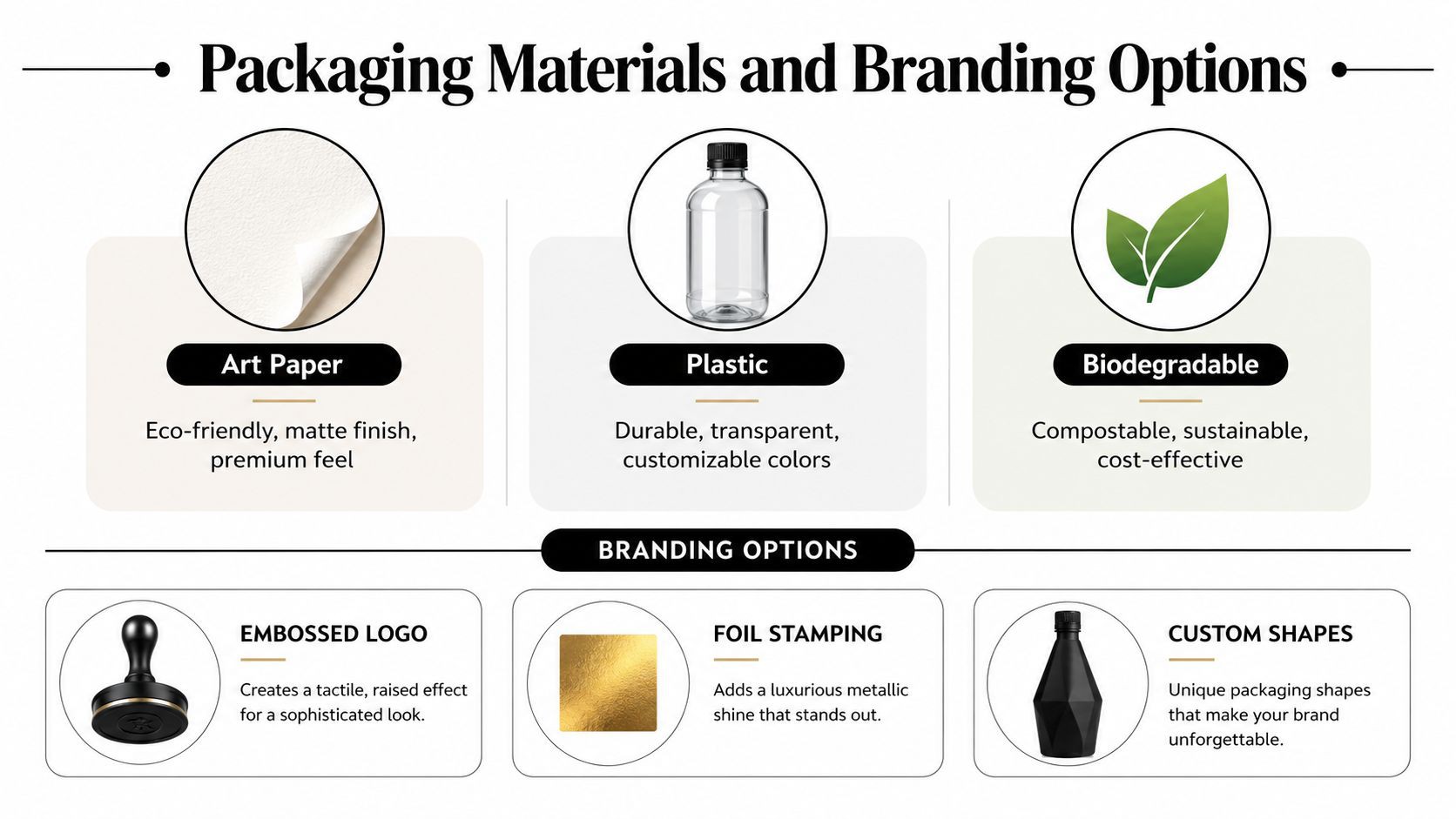
One FSC-certified wholesale example uses 157g art paper + 1200g greyboard, with soy-based eco ink, and lists certifications including FSC, ISO9001, and GRS, alongside a 500-set MOQ. That combination is useful because it shows how packaging, ink, and documentation fit together in a real procurement spec.
Art paper can support a more premium print finish, while greyboard adds stiffness and structure. Kraft paper sends a more natural signal and often fits eco-led brands. Bamboo-based containers can work well in niche presentations, but they should be used where the brand story can justify a more specialized format.
Embossing gives a kit tactile depth, while foil stamping adds visual contrast. Custom shapes can help a premium property stand out, but they can also increase complexity if the shape disrupts packing efficiency. The problem with overbranding is that it can make a simple item harder to manufacture, slower to replenish, and more expensive to ship.
Procurement note: ask suppliers how the box opens, stacks, and fills before you approve the artwork. Good-looking packaging that slows housekeeping is a bad trade.
The specification work is at the bid stage. Operators should require the carton-board grade, ink type, and certification set in writing, not just a sample photo. That avoids arguments later about whether a printed box is recyclable or merely styled to look that way.
The internal logic is straightforward, if your property is trying to reduce plastic, packaging is one of the first places to act. It doesn't fix every sustainability issue, but it can clean up the most visible part of the amenity story without changing the guest's ability to use the kit.
Sustainability has moved from branding language into procurement design. Hotels still need to give guests the basics, but the format can change depending on laundry capacity, stay length, and the operator's tolerance for maintenance. The question is no longer whether eco-friendly choices matter, it's which ones scale without creating new friction.
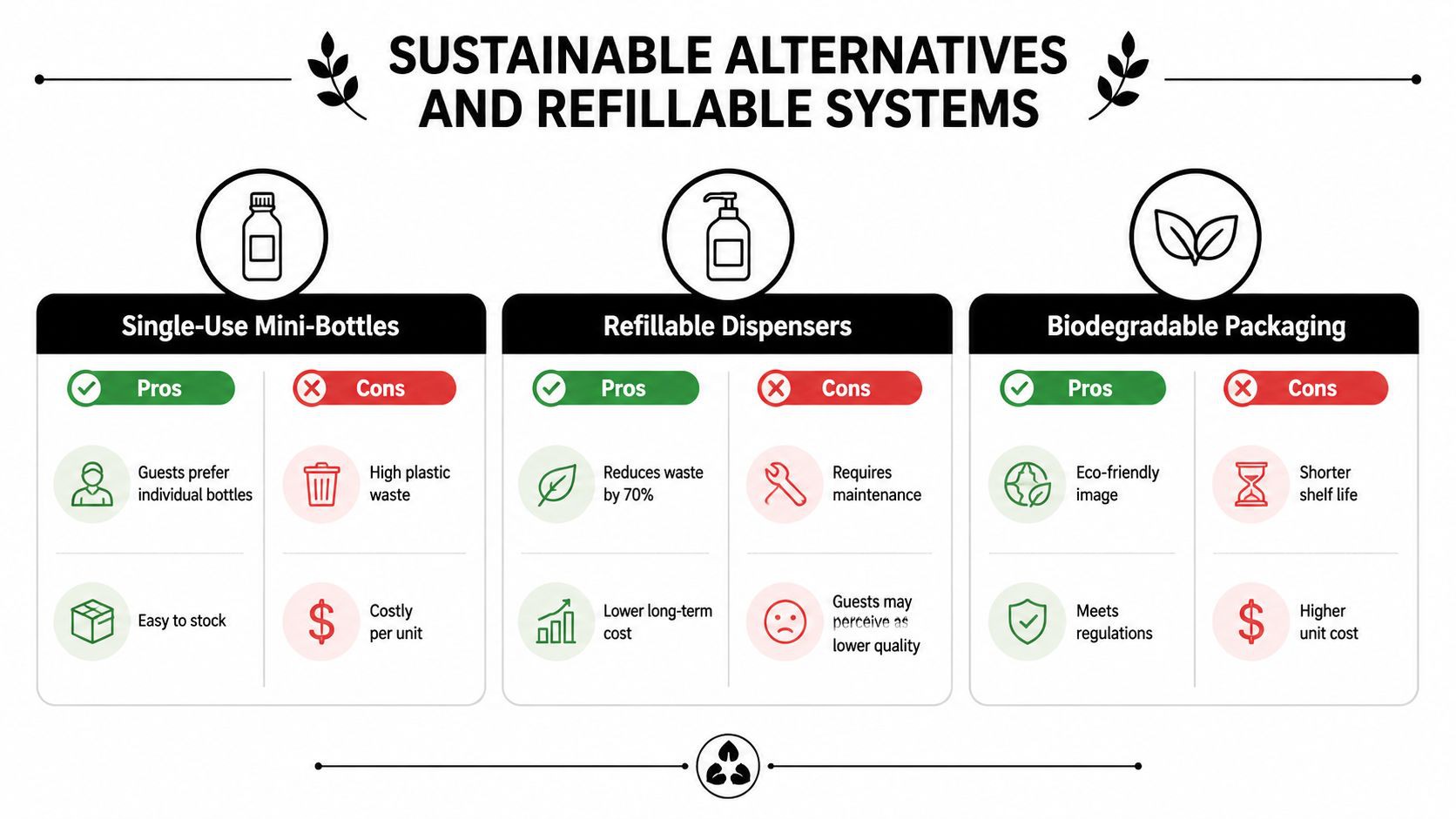
Single-use mini-bottles still win on guest familiarity. They're easy to stock and immediately legible at the room level. The downside is obvious, more waste and more pieces to reorder.
Refillable dispensers reduce packaging volume and fit well in properties with stronger housekeeping discipline. They can also simplify room setup once the workflow is stable. The trade-off is maintenance, because the hotel has to monitor fill levels, hygiene, and dispenser condition consistently.
Biodegradable packaging and materials can support an eco-forward brand story, especially in markets where owners want visible sustainability cues. But this option can bring shelf-life and unit-cost pressure, so it needs tighter vendor discipline.
The 2026 guidance emerging in hospitality supply is clear, properties are being pushed toward refillable bathroom amenities, transparent fees, and eco-oriented alternatives like bamboo handles, paper-based packaging, and organic-cotton alternatives. That doesn't mean every hotel should adopt the same system. It means the format has to fit the labor model as much as the brand story.
The most common mistake is choosing an eco format that looks strong in a pitch deck but slows the room team down. If a property can't inspect, refill, and replace the system reliably, the sustainability claim won't hold up operationally.
This guide to environmentally friendly linens for eco resorts pairs well with amenity decisions because the same procurement logic applies, material choice, guest expectations, and maintenance load all have to line up.
Eco packaging only works when housekeeping can support it every day, not when it looks good at launch.
For a lot of hotels, the most workable answer is a hybrid kit. Keep the high-touch, visible items aligned with brand and sustainability goals, then use refillable or reduced-packaging systems where the room workflow can handle them.
Procurement goes wrong fast when amenity kits are assembled category by category from different vendors. The result is duplicated emails, uneven branding, and quality that shifts from room to room. A better process starts with a full requirement list, then narrows to suppliers that can cover the needed mix without turning every reorder into a coordination problem.
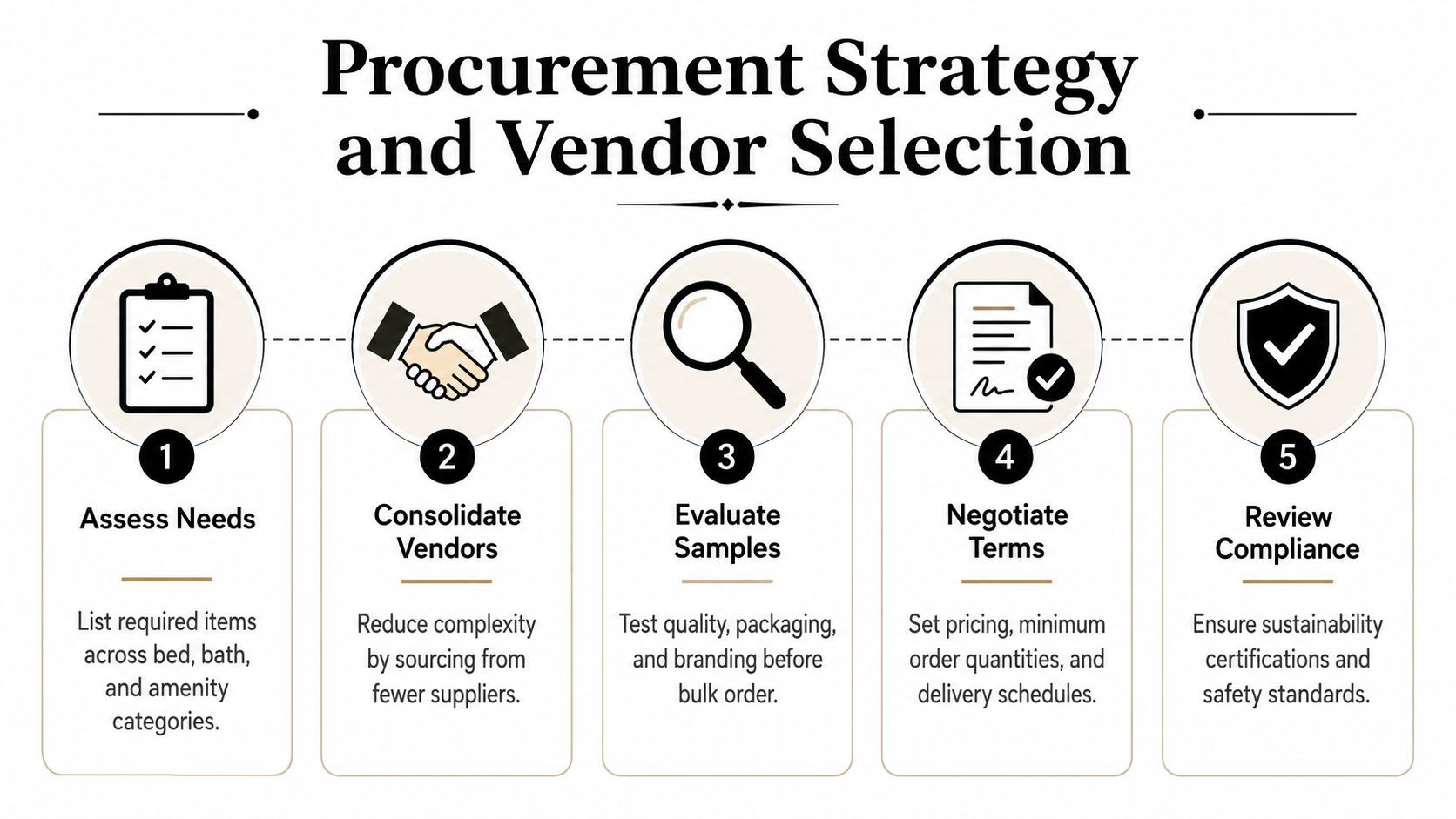
A useful bid sheet should name the item count, wrapper type, and physical dimensions. That matters because a few millimeters of variation can change box geometry, shelf display, and shipping cube utilization. It also keeps suppliers from quoting kits that look alike on paper but fail in the storeroom.
Minimum order quantity belongs in the first conversation, not after sample approval. The FSC example above shows how a 500-set MOQ can shape sourcing decisions, especially for smaller properties or seasonal programs. A hotel that cannot meet the MOQ needs either a different supplier or a different kit architecture.
The strongest vendors are usually the ones that can cover more than one category, because they reduce handoffs across bed, bath, and amenity purchasing. East West Hotel Textile is one such option, since it supplies hospitality textiles alongside amenities, slippers, and toiletries, which can help operators simplify sourcing without splitting the order across too many channels. Its hotel amenities supplier page is a practical starting point for teams comparing a wider room-wide purchase against a piecemeal buy. That kind of consolidation matters most when the goal is cleaner ordering, fewer samples to review, and less room for version drift.
One supplier does not solve everything, but it can cut the number of people you need to chase for the same room setup.
Before you place a bulk order, evaluate samples for packaging fit, wrapper quality, and the feel of the individual items. Then review documentation for sustainability claims and safety standards. Certifications such as FSC, ISO9001, and GRS are useful because they give procurement teams something concrete to verify during chain tenders.
The sourcing process should end with a simple control question, can this supplier keep the same kit consistent across repeat orders, or will every replenishment become a new negotiation? If the answer is unclear, the operational risk is higher than the price savings.
The next phase of amenity planning is less about adding features and more about making deliberate trade-offs. Hotels that win here will know which items their guests use, which package formats their housekeeping teams can support, and which sustainability claims they can document without stretching the operation.
A sensible 2026 kit strategy starts with a short list. Keep the high-utility items stable, trim the low-use extras, and decide where packaging, refill systems, and branding should carry the guest experience. Luxury properties can still feel generous, but generosity should come from relevance and consistency, not from a crowded box.
The best operators will treat the hotel amenities kit as part of a broader guest-room specification, not as a random add-on. That means aligning contents to property tier, using packaging that fits the brand and the compliance file, and consolidating vendors where it reduces noise. The market is expanding, but the winning procurement habit is still the same, buy only what the guest will notice, use, and remember.
If you're reviewing your next amenity refresh, East West Hotel Textile can help you source hotel bedding, bathroom linens, slippers, and room amenities from one procurement point. Visit East West Hotel Textile to compare product options and build a kit that fits your property tier, sustainability goals, and replenishment workflow.
Read More

The Whole List of All Three MICHELIN Key Hotels in 2026
Release date: 2026-10-07
EastWest Inside: Hotel Linen Manufacturing Process
Release date: 2026-09-21
Top Rated Pet-Friendly Hotels Around the World
Release date: 2026-09-08