


The Whole List of All Three MICHELIN Key Hotels in 2026
Release date: 2026-10-07Release Date: 2026-08-21 14:51:06
Your housekeeping team is already making the decision every morning. Should the cart carry minis, a dispenser refill bag, a backup dental kit, or nothing because the front desk handles it on request? That's not a cosmetic choice, it's a procurement system choice, and toiletries in hotels are one of the clearest places where guest expectation, labor, waste, and brand position collide.
The market tells the same story from the supplier side. One 2024 estimate valued the global hotel toiletries market at USD 24.3 billion and projected USD 45.29 billion by 2030, while other trackers place it at USD 31.7 billion in 2026 and USD 64.26 billion by 2033. Allied Market Research also projected USD 50.5 billion by 2031 from a USD 17.9 billion base in 2021, all of which points in the same direction, a fast-growing category that hotels no longer treat as an afterthought. Grand View Research's hotel toiletries market report makes the scale obvious.
A guest arrives tired, drops a bag, and goes straight for the bathroom. That's where the first procurement mistake shows up. If the shampoo is hidden, the soap feels flimsy, or the room has no toothbrush when the guest needs one, your team has turned a simple morning routine into a complaint.
Guest behavior is not subtle. In a 2024 Hilton survey, 73% of American travelers admitted to taking hotel toiletries, and 52% said they love in-room toiletries so much that they use everything available. A separate study cited by Freakonomics found 86% of hotel guests use packaged soaps, and industry reporting says more than 75% of hotel guests use the toiletries provided. Those figures are why toiletries in hotels stay operationally important, even when the product itself looks small.
That usage changes housekeeping work in a very direct way. A room with visible, standardized amenities is faster to reset than one where attendants have to check odd combinations of minis, half-used bottles, or missing backup items. It also changes reviews, because guests read bathroom presentation as a signal of care, not just convenience.
Practical rule: If a guest notices the toiletries as a problem, the specification is already wrong.
The right question is not whether guests notice toiletries. They do, constantly. The right question is whether the bathroom setup makes them feel looked after without creating extra labor or waste for your team. That's why amenity decisions belong in procurement, not as a last-minute housekeeping purchase.
A hotel bathroom should separate table-stakes items from request-only items. If you blur that line, you either overstock the room or frustrate guests who assume basics will be there. A useful reference point is this hotel bathroom amenities guide, but effective procurement discipline is deciding what belongs in sight, what belongs in back-of-house, and what can stay off-property entirely.
The core set is simple. Shampoo, conditioner, body wash or bar soap, and lotion are the items guests expect to find without asking. Typical travel-size references put shampoo and conditioner around 15 to 30 mL, body wash at 30 to 60 mL, lotion at 20 to 40 mL, and bar soap at 25 to 40 g. Another hospitality guide notes that guest-room toiletries are commonly specified as individually wrapped soaps plus 30 to 50 mL shampoo and conditioner bottles.
The next layer is where tier shows up. Shower caps, dental kits, shaving kits, vanity kits, combs, and sewing kits are all common differentiators. Budget and midscale properties often keep them on request or in back-of-house stock. Upscale and luxury properties put more of them in the room, or at least make them easy to deliver without friction.
Toothpaste, toothbrushes, razors, mouthwash, cotton swabs, sanitary items, and basic first-aid supplies often sit outside the bathroom and move only when the guest asks. That's not a failure of service, it's a deliberate inventory decision. The operational point is to make the request easy, because hidden amenities might as well not exist if guests don't know they can get them.
| Category | Typical Items | Placement |
|---|---|---|
| Core wash items | Shampoo, conditioner, body wash, bar soap, lotion | Bathroom, always visible |
| Grooming extras | Shower cap, comb, shaving kit | Bathroom or vanity, depending on tier |
| Dental items | Toothbrush, toothpaste, floss, mouthwash | Request or premium room set |
| Vanity and care | Cotton swabs, sewing kit, sanitary items | Request or back-of-house |
| Support items | First-aid basics, extra razors, repair kits | Back-of-house only |
Guests judge the bathroom by what's missing, not by what's listed in a procurement spreadsheet.
The packaging format is the message. A guest reads the bottle shape, the seal, and the dispenser mount before they read the label. That means procurement needs to choose format with intention, not just price.
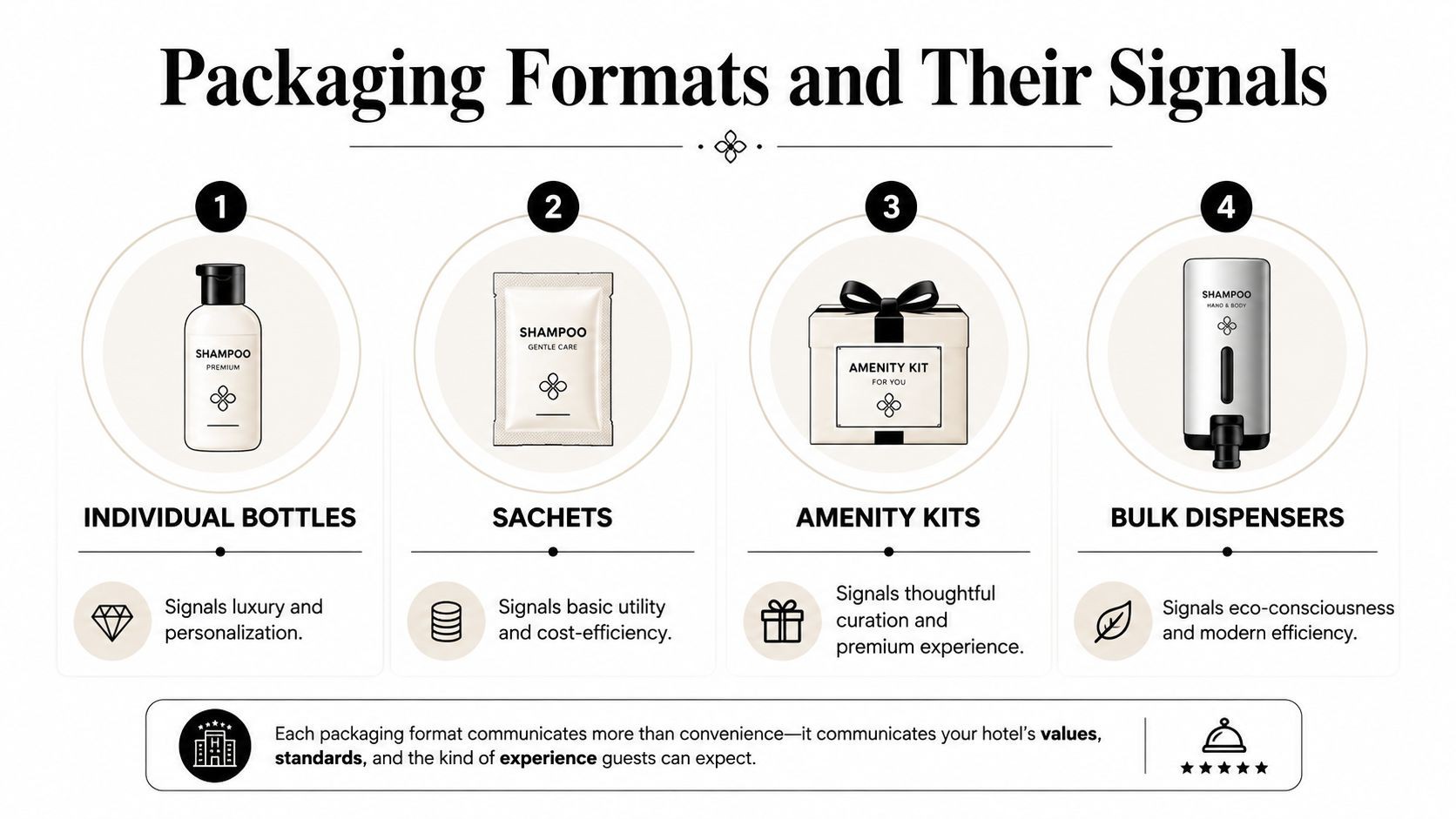
Individual bottles signal generosity and a more personal room experience. They're easy for guests to understand, easy to photograph for listings, and still the cleanest fit for many upscale rooms. They also create more packaging to manage and more replenishment touches.
Sachets signal basic utility and cost control. They work in short-stay or high-turnover properties, but they rarely feel premium. They also tend to be the least elegant option once the guest is in the shower.
Amenity kits signal curation. When the packaging is tidy and the items are grouped well, guests read that as intentional service. The downside is obvious, they can look luxurious while still carrying very small product volumes.
Bulk dispensers signal modern efficiency and a more sustainability-minded operation. That's especially true when the hardware is locked, labeled clearly, and easy for housekeeping to refill. As the earlier section noted, format drives workflow, and workflow drives cost.
Printed bottles look more finished than plain stock, but private label only works if the design stays readable in a wet bathroom. Tamper-evident seals matter on minis, especially in guest-facing premium rooms. Refillable systems need visible labeling for shampoo, conditioner, and body wash, because the guest should never have to guess what's in the chamber.
If you're buying sets rather than single SKUs, hotel shampoo set options are worth reviewing as a packaging exercise, not just a product exercise. The best set is the one that matches your room type and housekeeping rhythm, not the prettiest bottle on a sample sheet.
Tier-based specification is where most hotels either overbuy or underspecify. Economy properties need consistency and speed. Luxury properties need a product story. Midscale and upscale sit in the middle and can win with clean formulation and disciplined presentation.
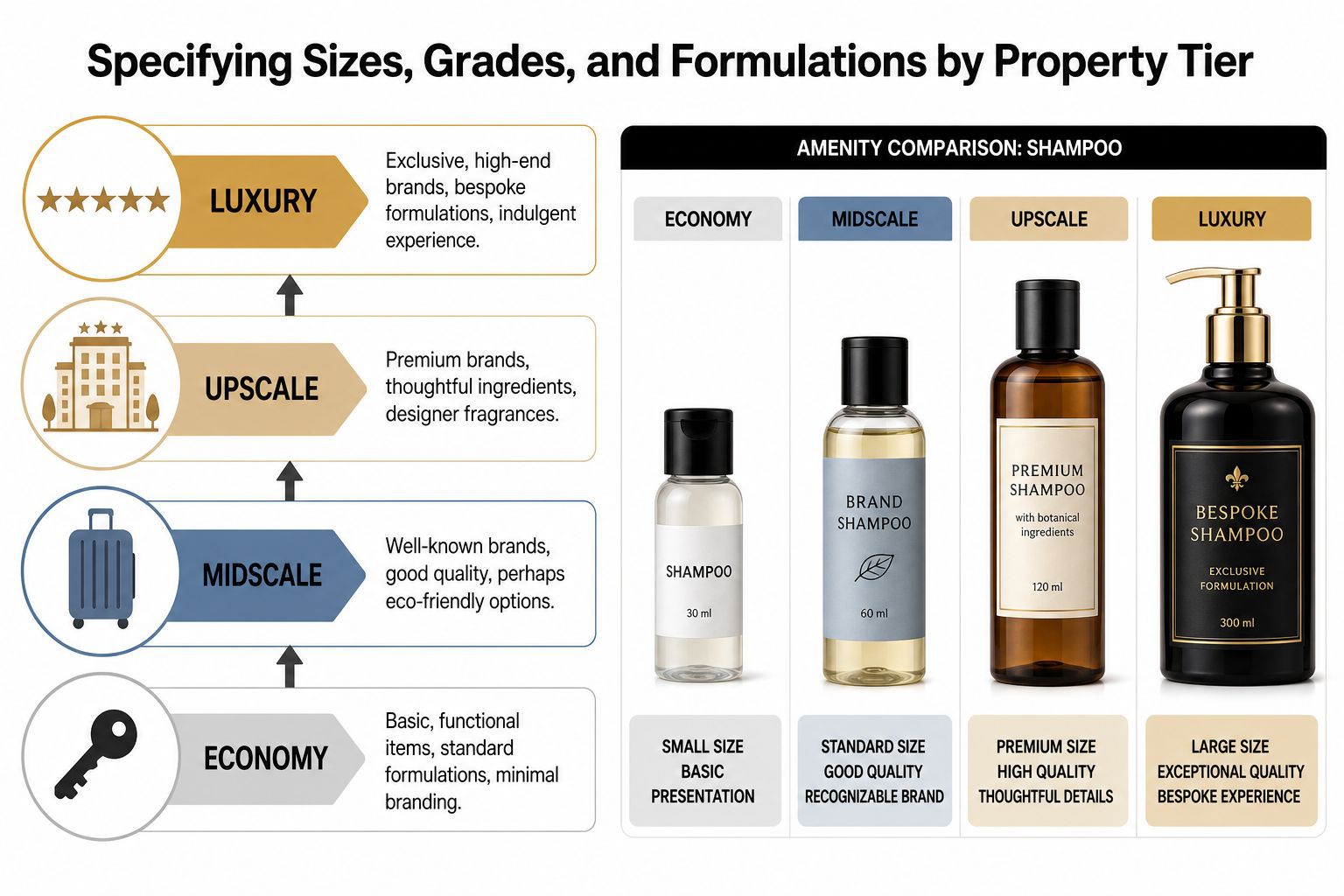
For economy, keep it functional. Smaller sachet-style amenities and standard formulations are fine when the room rate and turnover model demand speed. Midscale can move to better-looking bottles, clearer labeling, and stronger consistency across SKUs. Upscale should lean into better ingredients, more thoughtful fragrance, and cleaner packaging. Luxury can justify bespoke or brand-linked lines when the bathroom is part of the stay, not just a utility space.
Paraben-free and sulfate-free positioning usually makes sense at midscale and above, especially when the rest of the room already suggests care. Vegan and cruelty-free claims can also strengthen the amenity story if they're consistent across the property. Fragrance should be controlled, not loud. The guest remembers a pleasant scent; they complain about a bathroom that smells like a retail aisle.
Rule of thumb: If the bottle looks premium but the formulation feels generic, the guest notices the disconnect immediately.
Ingredient disclosure, safety documentation, and shelf-life tracking matter just as much as the sensory side. If you're importing or distributing across markets, the label has to be legible and compliant for the places you operate in. Don't let a pretty sample override the spec sheet. Procurement should ask for documentation before the first PO, not after the first guest complaint.
The industry shift is real, but it's not binary. Minis still make sense in some properties. Refillable systems make more sense in others. The right answer depends on theft risk, labor model, guest expectations, and whether your brand wants the bathroom to read as curated or efficient.
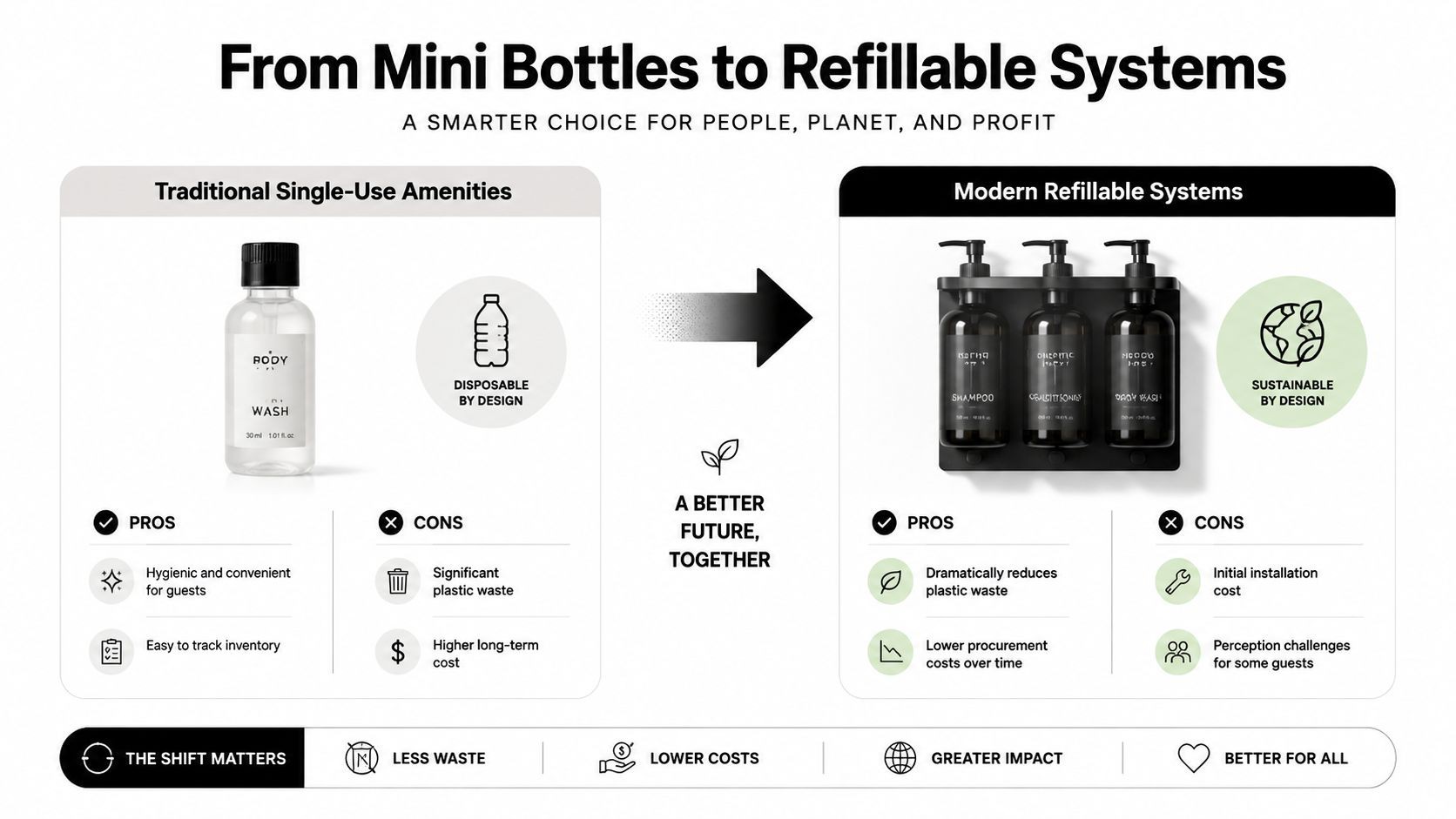
Industry guidance for hotel supply systems recommends vandal-resistant locking, labeled chambers for shampoo, conditioner, and body wash, and easy-refill back-fill ports because those features improve refill efficiency and reduce product loss in high-turnover bathrooms. The same logic appears in paper systems, where jumbo-roll setups are reported to cut paper use by 20 to 25% versus standard rolls by limiting sheet pull. Hotel supply guidance is useful because it shows the mechanism, controlled dispense reduces waste when the system is designed properly.
That's the procurement lesson. The win is not “dispensers are better.” The win is “controlled delivery reduces handling, loss, and excess use when the bathroom is set up for it.”
A good hybrid setup keeps the highest-volume liquids in dispensers and preserves minis for items that signal value or feel more personal. Shampoo, body wash, and hand soap are usually the first candidates for refillable systems. Conditioner, specialty scents, or room-category upgrades can stay in mini format when the property wants a more premium touch.
If your ownership group wants a guest-facing sustainability story, say it plainly. Guests can accept refillables when the hardware is clean, secure, and clearly maintained. They push back when dispensers look improvised or neglected.
Practical rule: Put dispensers where usage is highest and guest scrutiny is lowest, then reserve minis for the items that actually support the room's price point.
Buyers waste time when they shop toiletries as isolated products. That's the wrong model. The better model is supplier capability, documentation, replenishment fit, and cross-category consolidation. A single vendor that can cover amenities, slippers, and related OS&E reduces fragmentation, and East West Hotel Textile's amenity and supply catalog fits that one-stop approach because it spans bathroom amenities alongside broader hospitality supplies.
Start with samples, then test them in an actual guest room. Judge the seal, the opening behavior, the label readability, the scent strength, and how the product looks after a housekeeping reset. A pretty sample that doesn't survive humid bathroom conditions is not a usable product.
After that, ask for the boring stuff. MOQ flexibility matters if you're standardizing across several properties. Lead time matters if occupancy spikes and your par levels tighten. Private-label capability matters if the bathroom is part of your brand story. Documentation matters if you import across multiple markets.
Sample pack by property tier: Ask for economy, midscale, and premium options, not a single generic line.
Housekeeping fit: Confirm whether the package is faster to stock, refill, or replace.
Category breadth: See whether the supplier can cover shampoo, shower gel, conditioner, body lotion, soap, shower cap, dental kit, shaving kit, vanity kit, and comb together.
Order structure: Check whether case packs align with your par levels instead of forcing odd leftovers.
Communication path: Direct response channels and clear catalogs matter because replenishment is an operational relationship, not a one-time sale.
You do not need one vendor for every item in the bathroom. You do need a sourcing plan that keeps the team from juggling incompatible SKUs and inconsistent packaging. If one supplier can cover the core amenity set cleanly and another can do a higher-end branded line for suites, that can be smarter than forcing everything into one contract.
The bathroom spec only works when the four decisions line up. Amenity mix, packaging format, specification tier, and supply model all have to support the same guest experience. If they don't, you end up with a beautiful bottle that slows housekeeping, or a sustainable dispenser that doesn't match the room's price point.
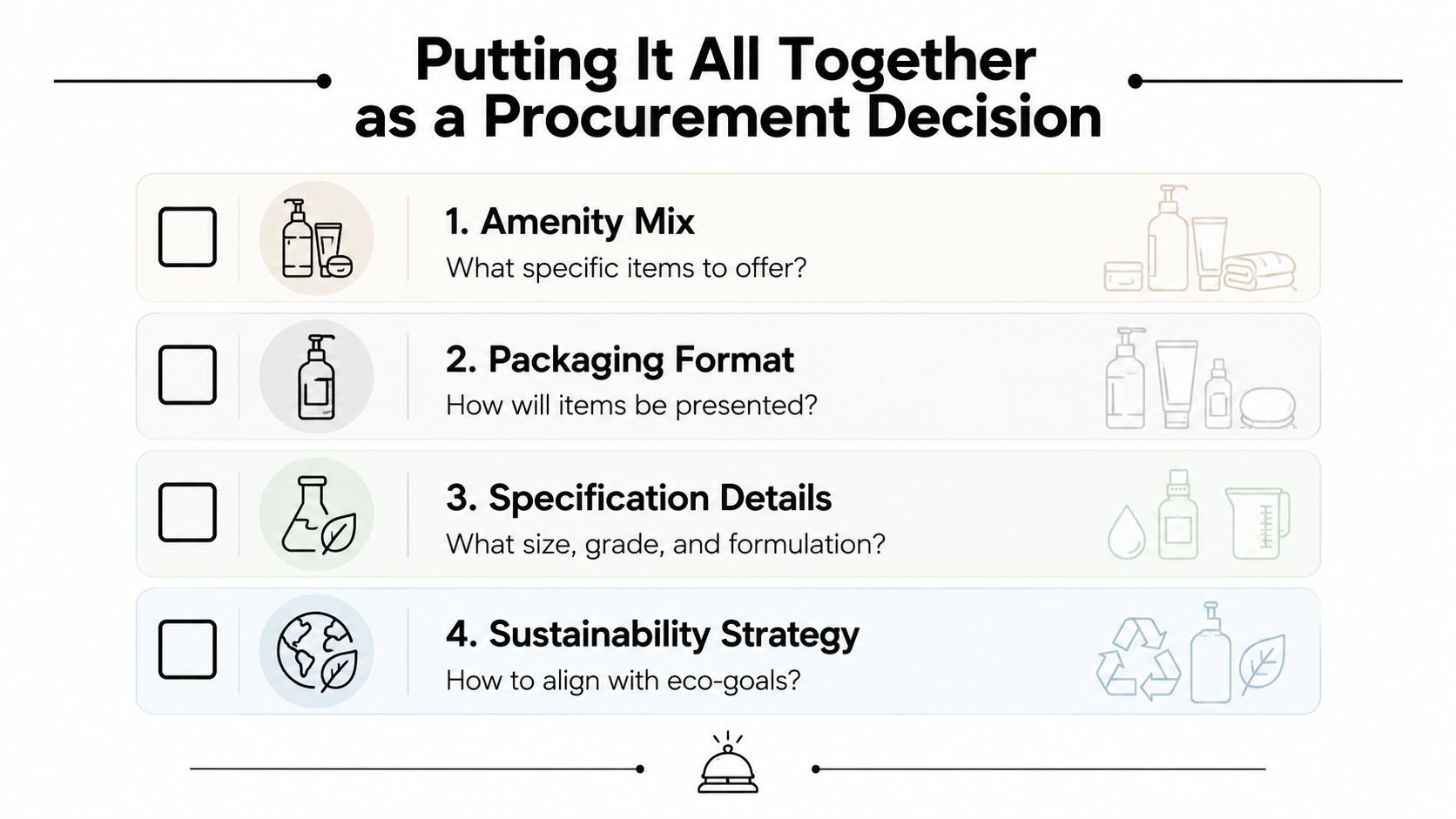
Amenity Mix: Decide which items belong in the room and which stay on request.
Packaging Format: Choose bottles, sachets, kits, or dispensers based on the brand signal you want.
Specification Details: Lock the size, grade, formulation, and documentation.
Sustainability Strategy: Decide whether the property uses minis, refillables, or a hybrid setup.
The items most often left to the front desk are the ones guests ask for inconsistently, like toothpaste, dental floss, razors, and period products. That's fine as long as the request path is smooth. A guest who gets what they need quickly still reads the stay as well managed.
A bathroom spec is not just a purchasing line. It is a brand decision with housekeeping consequences. Treat it that way, and you'll buy better, restock faster, and get fewer complaints about the one room element every guest touches.
East West Hotel Textile supplies hotel toiletries, bathroom linens, slippers, and other hospitality operating items in one procurement flow, which is useful when you want the bathroom spec to match the rest of the room. Visit East West Hotel Textile to review supply options and build a toiletries program that fits your property tier, housekeeping workflow, and replenishment model.
Read More

The Whole List of All Three MICHELIN Key Hotels in 2026
Release date: 2026-10-07
EastWest Inside: Hotel Linen Manufacturing Process
Release date: 2026-09-21
Top Rated Pet-Friendly Hotels Around the World
Release date: 2026-09-08