


Top Rated Pet-Friendly Hotels Around the World
Release date: 2026-09-08Release Date: 2026-07-30 14:00:44
Marriott International vs. Hilton Group: Latest Business Competition Overview (As of July 2026)
Both groups employ an asset-light model (management contracts + franchising) rather than holding significant property assets. Competition centers on six key areas: global scale, loyalty programs, brand portfolios, regional expansion, renovation of existing hotels, and the pursuit of investors. While their strategies overlap in places, their operational paths diverge significantly.
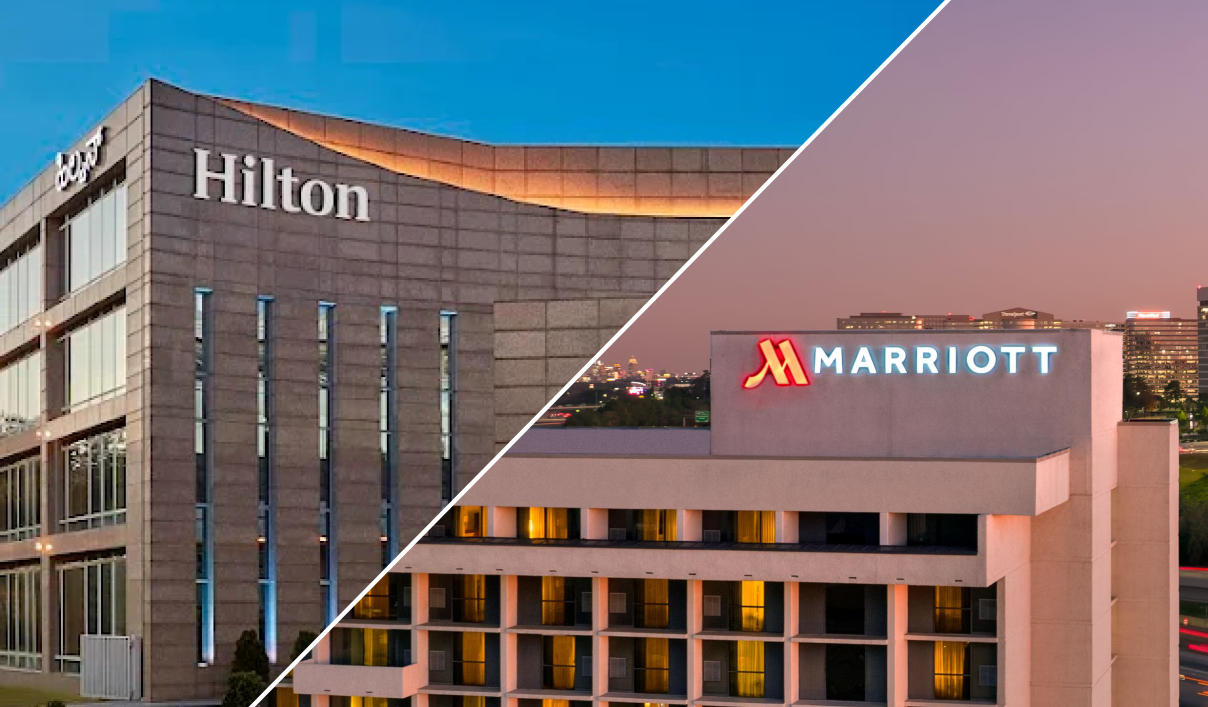
Marriott International (Industry Leader; #1 in Scale)
Over 9,100 open hotels and approximately 1.67 million rooms globally; pipeline of ~610,000 rooms under development.
Annual revenue of $26.186 billion and net profit of $2.601 billion; ranked first in the industry for both revenue and profit.
Portfolio of 37 brands, covering the full spectrum from luxury and upscale to mid-scale, extended-stay, and soft brands.
Hilton Group (Faster Growth Rate)
Approximately 7,000+ open hotels globally; pipeline of 527,000 rooms.
Annual revenue of $12.039 billion (up 7.74% year-over-year), with a faster revenue growth rate than Marriott; net room growth of 6.7% for the year, leading the industry in expansion speed.
Fewer brands than Marriott, but rapid growth in mid-scale and economy-focused brands; the Hilton flagship brand has held the title of the world's most valuable hotel brand for 11 consecutive years.
Core Landscape: Marriott wins on absolute scale and its luxury brand lineup; Hilton wins on expansion speed and mid-scale market penetration.
Loyalty programs serve as the most critical "moats" for both companies; in 2026, both are simultaneously overhauling their rules and competing head-to-head for frequent travelers:
Hilton Honors
Implementing major reforms in January 2026:
Introduces a new top-tier status, "Diamond Reserve," requiring both a minimum number of nights and a minimum spend, aiming to lock in high-spending, elite guests;
Significantly lowers the thresholds for retaining Gold and Diamond status to attract mid-frequency business travelers; retains free breakfast benefits for Gold members, increasing appeal to the average traveler;
Integrates independent hotel brand YOTEL via "Select by Hilton," expanding available inventory without the need for acquisition; establishes cross-platform membership integration with Didi.
Weaknesses: Mass status upgrades have diluted Diamond benefits and led to overcrowded executive lounges; points continue to undergo slight devaluation, causing dissatisfaction among long-time members.
Marriott Bonvoy
Maintains a steady course with no major changes to the overall program architecture:
Keeps the threshold for the top-tier Ambassador status high (100 nights + $23,000 spend) rather than loosening requirements indiscriminately;
Eliminates the previously popular "double elite nights" promotion and tightens night-counting policies to curb "mattress running" (low-cost status retention);
Partners with Meituan for membership status matching, leveraging local lifestyle traffic in China;
Strengths: A larger global inventory for award redemptions; Weaknesses: Gold status lacks a globally standardized free breakfast benefit, making entry-level membership less attractive than Hilton's.
Competitive Conclusion: Hilton is taking the offensive to capture mid-market business travelers, while Marriott is defending its high-end, high-value client base and avoiding the over-proliferation of elite statuses. Market analysts predict that by the end of 2026, Hilton Honors' total membership could approach or even surpass that of Marriott Bonvoy.
Industry consensus holds that growth potential in the luxury market is limited; the core growth drivers lie in mid-scale, economy, extended-stay, and conversion (rebranding existing properties) segments. Both companies are aggressively vying for these areas:
Marriott’s Approach: A comprehensive multi-brand network built through a combination of acquisitions and in-house launches.
Economy/Mid-scale: Relies on acquired brands like City Express (Latin American economy segment) and the extended-stay brand StudioRes; launched the "Series by Marriott" soft brand to capture independent hotels for conversion.
Solid Luxury Advantage: St. Regis, The Ritz-Carlton, and EDITION form a formidable luxury lineup, with a distinct edge in the high-end resort market.
Weaknesses: A late start in the economy segment; its footprint in the mass-market/budget sector is weaker than that of Hilton’s Hampton brand.
Hilton’s Approach: Rapid market penetration driven by its mid-scale powerhouse "Hampton," alongside the continuous introduction of niche brands.
Hampton is one of the world's largest mid-scale hotel brands and a key tool for penetrating Tier 3 and Tier 4 cities; the budget brand "Spark" is capturing a large volume of older hotels for rebranding.
Continuous expansion into niche segments: Introducing the lifestyle brand "Tempo" to China by 2026; launching the "Apartment Collection" to target the extended-stay market; global expansion of the high-end conference brand "Signia"; and the "Outset Collection" soft brand to absorb independent hotels.
Weaknesses: The number of luxury properties (Waldorf Astoria, Conrad) is significantly lower than Marriott’s, placing it in a defensive position within the ultra-luxury market.
Brief Summary: Marriott has a higher ceiling (stronger luxury presence); Hilton has a broader base (stronger capability to penetrate the mid-scale market).
Hilton
Set to officially reach the milestone of 1,000 hotels in China by early 2026; expanding at a faster pace, with Hampton continuing to penetrate domestic Tier 3 and Tier 4 cities; aims to scale up to 2,000 hotels in China over the coming years; RevPAR growth in the Asia-Pacific region is outperforming Marriott’s China operations.
Marriott
With approximately 700 hotels open in China, it remains some distance away from the 1,000-hotel milestone; RevPAR in Greater China faces pressure for 2025–2026, with average room rates declining; the company is accelerating the Fairfield brand (strengthening recognition of its Chinese name) and introducing the "Collection" soft brands; expansion relies increasingly on franchise partnerships with domestic hotel groups.
Regional characteristics: Marriott holds an advantage in the high-end market of Tier-1 cities; in Tier-2 and Tier-3 cities and lower-tier markets, Hilton Garden Inn and Hampton by Hilton are capturing a larger share of property resources.
India: Both groups are aggressively ramping up investment. Marriott has deepened ties by acquiring a minority stake in a local hotel management company; Hilton is rapidly signing new projects in small and medium-sized cities to capture the fast-growing local business travel demand.
Middle East & North Africa: Hilton has recently intensified efforts in markets like Morocco, launching luxury projects such as Waldorf Astoria; Marriott maintains a stable advantage by leveraging its existing portfolio of resorts and business hotels.
Latin America: Marriott holds a first-mover advantage with the City Express brand; Hilton is accelerating to catch up.
✅ Marriott International Strengths
Leading by a wide margin in total global room count and number of luxury brands;
Stronger footprint in resorts and island destinations;
Extensive resources for corporate client agreements;
Long-term stability in loyalty program benefits with minimal volatility.
❌ Weaknesses: Limited appeal for entry-level members; late start in the economy/lower-tier segment; short-term operational metrics in China are under pressure.
✅ Hilton Group Strengths
Faster expansion pace and exceptional scalability for mid-scale brands;
Free breakfast for Gold members attracts a large number of leisure travelers;
Flexible rebranding solutions for existing hotels appeal strongly to property owners;
Rapid expansion pace in China with an aggressive push into lower-tier markets.
❌ Weaknesses: Insufficient scale in the luxury segment; frequent adjustments to loyalty program rules have sparked controversy; long-term pressure on point devaluation.
Competition is shifting from the mere construction of new hotels to a battle for the conversion of existing properties: both sides are aggressively promoting "soft brands" to vie for partnerships with struggling independent hotels looking to rebrand.
A "dual-track" strategy persists: ramping up budget-friendly mid-scale offerings to capture mass-market traffic while simultaneously expanding luxury resort projects to attract high-net-worth clientele.
Intense competition in loyalty programs continues: Hilton is highly likely to maintain its accessible mid-scale membership policies, while Marriott is unlikely to easily lower the entry thresholds for its high-end tiers.
The Chinese market is the decisive battleground: with the robust rise of domestic hotel chains, both international giants must rely on franchising and expansion into lower-tier cities to sustain growth.
Direct M&A between the two rivals is highly unlikely; the industry has entered a phase of differentiated, refined competition, making a scenario where one party rapidly swallows the other improbable.
How should the average traveler choose between Marriott and Hilton? Alternatively, from the perspective of a hotel investor, which brand offers greater advantages for franchising—Marriott or Hilton?
Key Differentiators: Annual stay frequency, importance of free breakfast, preference for leisure vs. business travel, and ability to consistently maintain elite status.
| Comparison Item | Marriott Bonvoy | Hilton Honors |
| Threshold for High-Tier Status | Gold: 25 nights; Platinum (50 nights) required for breakfast/lounge access No standard free breakfast for Gold members (major drawback) | Gold: Only 25 nights or 15 stays required; includes free breakfast for two |
| High-Tier Membership Benefits | Platinum/Titanium: Executive lounge access, priority suite upgrades, 4 PM late check-out (subject to availability); Huge selection of luxury brands (Ritz-Carlton, St. Regis, W); major advantage for island resort vacation | Diamond: Guaranteed breakfast; upgrades usually involve better floors or views, with lower probability of suite upgrades compared to Marriott; New "Diamond Elite" tier raises the bar for top-tier status |
| Points Policy | Dynamic pricing; "Stay 5, Pay for 4" (5th night free) on award stays; slightly higher point value; largest global inventory for redemptions | Dynamic pricing; frequent point-purchase promotions; low redemption costs for mid-range hotels |
| Hotel Amenities | For Marriott hotel bedding, mostly use 300TC for sheets, has both down and microfiber duvet/pillow for high-end brands. For shampoo set, Fairfield features Paul Mitchell products, Aloft features Pharma or Drybar styling products, and Moxy uses quirky, custom-formulated bulk options. | For Hilton hotel bedding, mostly use 200~250TC for sheets, has both down and microfiber duvet/pillow for high-end brands For shampoo set, Hampton uses Beekman 1802, Tru utilizes bulk Not Soap, Radio lines, and Hilton Garden Inn features Peter Thomas Roth.. |
| Drawbacks | Gold status offers few practical perks; infrequent travelers rarely see real value; fierce competition for upgrades during peak holidays | High number of Diamond members dilutes benefits; mid-range brands (like Hampton) lack executive lounges; inconsistent breakfast quality at some properties |
1. You stay fewer than 30 nights a year (infrequent business or family travel) and don't want the hassle of "mattress running" (booking extra nights) to hit the 50-night requirement for status retention.
2. You simply want Gold status to guarantee free breakfast for two—the most practical benefit for the average traveler. You frequently take short trips to second- and third-tier cities or prefecture-level cities in China, with a hotel budget of 300–600 RMB, usually staying at mid-range chain hotels.
3. You aren't interested in suites or executive lounges; your core priorities are convenience and saving on breakfast costs.
4. You travel frequently between China and the US, where Hilton has a very high density of properties.
1. You stay 40–50+ nights a year, travel frequently for business, and can maintain Platinum status.
Platinum status unlocks full access to lounges, afternoon tea, and evening happy hours, plus a high probability of suite upgrades.
2. You love island getaways and high-end travel, favoring luxury brands like Ritz-Carlton, St. Regis, EDITION, and W Hotels.
3. You frequently visit Southeast Asia or island resorts and want a wider range of global travel destinations.
4. You need late check-out (until 4 PM) due to frequent late-night flights; Marriott offers more reliable delivery of these benefits.
A minimalist summary for travelers:
Infrequent/casual travelers (dozens of nights or fewer per year) → Hilton is the better choice.
Frequent business travelers and luxury vacation enthusiasts → Marriott is the better choice.
A quick tip: Don't blindly try to maintain status with both programs at once. Average travelers should focus on mastering one system and concentrating their stays to reach higher tiers; splitting stays between the two often results in failing to secure high-level benefits with either.
First, the premise: For the average investor in China looking at these two major international brands, the primary point of comparison lies between Hilton Garden Inn (Hampton by Hilton in China) and Marriott’s Fairfield (the key mid-scale offerings). High-end full-service hotels have extremely high investment thresholds and are rarely pursued by typical investors.
Minimum 120 guest rooms; minimum gross floor area of 28 sqm per room;
Fit-out cost: Approx. 170,000–200,000 RMB per room (excluding rent);
Ongoing fees: Management fees + brand fees totaling approx. 6% of room revenue;
Cooperation term: 10 years.
① Market maturity: Leading position in China’s "lower-tier" markets; enjoys high recognition for properties in Tier 3 and 4 cities, near high-speed railway stations, and in new development zones; the top choice for property owners seeking an international mid-scale brand;
② Balanced guest mix: Stable flow of Hilton Honors members and a large volume of individual business travelers; occupancy rates in many cities outperform comparable Fairfield properties;
③ Lower operational complexity: A limited-service brand that does not require a full executive lounge, resulting in lower labor costs and reduced investment in food and beverage (F&B) facilities;
④ High market recognition: Perceived by consumers as an "affordable international five-star" experience; superior pricing power compared to domestic mid-scale brands.
① Price wars/cannibalization when multiple properties cluster in the same city;
② The brand owner holds the upper hand in contract renewal negotiations;
③ Ongoing expenses for member commissions and system fees continuously erode net profit.
Recommended 120+ guest rooms; stricter requirements for lobby design and property visibility/facade;
Fit-out standards are slightly higher than Hampton, with per-room investment generally 5%–10% higher;
Combined ongoing fee rate is similarly around 5.5%–6.5%;
Preference for core locations in provincial capitals, Tier 1 cities, and strong Tier 2 cities.
① Stronger pricing power (premium rates) in core business districts of Tier-1 cities and provincial capitals; average daily rates (ADR) are generally higher than Hampton properties in the same city;
② Larger base of high-tier Marriott Bonvoy members and a higher proportion of high-spending guests; stronger access to corporate account agreements;
③ Significant potential for future upgrades; once operations stabilize, the property can be converted into an upscale brand like Marriott or Sheraton.
① Less favorable for lower-tier markets; securing a Fairfield license for prefecture-level cities or counties is difficult, as the brand owner is extremely selective about locations;
② Higher hardware standards and total development costs, resulting in a longer payback period;
③ In Tier-3 and Tier-4 cities, the brand's advantage in attracting traffic is harder to leverage, making it difficult to compete against Hampton.
Marriott Advantages: Dominant luxury brand portfolio. St. Regis, Ritz-Carlton, and EDITION resort projects command strong premiums; Marriott is the preferred choice for high-end cultural tourism and coastal projects. Stronger resources for large corporate conferences and team-building events.
Hilton Advantages: Fewer Waldorf Astoria and Conrad properties; however, expansion of new projects in China is more flexible, and securing a license is slightly easier than with Marriott in some cities.
Objective Reality: Total investment for a single upscale full-service project often runs into the hundreds of millions, making it generally unfeasible for small-to-medium investors.
✅ Prioritize Hilton(with Hampton as the top choice) if any of the following apply:
The property is located in a Tier-3 or Tier-4 city, a prefecture-level city, a transportation hub, or a non-core business district;
Budget is limited, with a desire to control renovation and labor/operating costs;
The goal is steady occupancy and reliance on the member-based guest flow, rather than aggressively pursuing ultra-high room rates;
The property size is 120–150 rooms (limited-service hotel), and there is no desire to operate large-scale F&B facilities or executive lounges.
✅ Prioritize Marriott (specifically Fairfield or Courtyard) if any of the following apply:
The property is located in the core business districts or tourist resort areas of Tier 1, provincial capital, or "New Tier 1" cities;
The target clientele consists of multinational corporations and high-end business travelers, with the aim of driving up the Average Daily Rate (ADR);
Capital is sufficient to support higher renovation standards, and there is a long-term plan to eventually upgrade to a high-end brand;
The city already has multiple Hampton by Hilton properties, leading to market saturation; choosing Marriott avoids head-to-head competition with identical offerings.
Both major groups operate on an asset-light franchise model; the brands do not guarantee returns or underwrite occupancy rates. Profitability ultimately depends on location and rental costs; the brand provides a boost in traffic but is not a guarantee of profit.
Ongoing brand fees range from 5% to 6.5%; when combined with OTA commissions, this creates a "double dip" into revenue—these costs must be factored into return projections.
In recent years, both groups have aggressively expanded their "soft brands" (e.g., Marriott’s "Series" collection). These are suitable for renovating older, existing hotels; investment costs are lower than standard franchise brands, making them a viable alternative.
For Travelers
Travel infrequently, want reliable free breakfast, and often visit Tier 3 or 4 cities → Hilton
Frequent business traveler, enjoy luxury resort hotels, and prioritize suites/executive lounges → Marriott
For Hotel Investors
Tier 3 or 4 cities, cost-conscious, steady operations, limited-service mid-scale hotel → Hampton by Hilton
Tier 1 or 2 core business districts, ample budget, targeting high-end business travelers, seeking premium room rates → Marriott Fairfield / Courtyard
Read More

Top Rated Pet-Friendly Hotels Around the World
Release date: 2026-09-08
Which Hotels Have the Best Hotel Views In The World?
Release date: 2026-09-03
Which 5 Star Hotel Brand Has the Best Hotel Bedding?
Release date: 2026-08-31